- Phylum
- Cyanobacteriophyta
- Class
- Cyanophyceae
- Order
- Nostocales
- Habitat
- plankton
- Distinctive features
- gas-vacuolated filamentous cyanobacterium, often with and/or . End-cells are bluntly rounded, thinner than other cells, often colorless. Filament diameter larger than that of Raphidiopsis (previously Cylindrospermopsis) raciborskii.
- Organization
- filamentous
- Color
- pale blue-green
- Cell diameter (D)
- 3.0–4.4 µm, median: 3.4 µm (N=3980). Cell diameter varies significantly over an annual cycle, making it necessary to measure it routinely
- Cell length (L)
- not measured, only filament length was measured
- Cell biovolume
- not computed, only filament volume was computed
- Biovolume equation
- Cylinder, V = 2 π L (D/2)2, where L=filament length
- Filament length
- 20–1100 µm, median: 190 µm (N=3980)
Morphological features
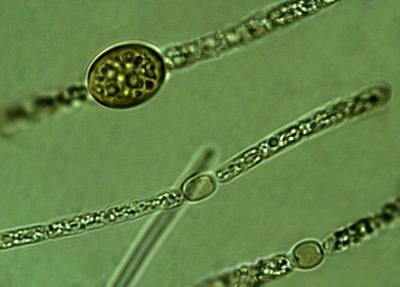
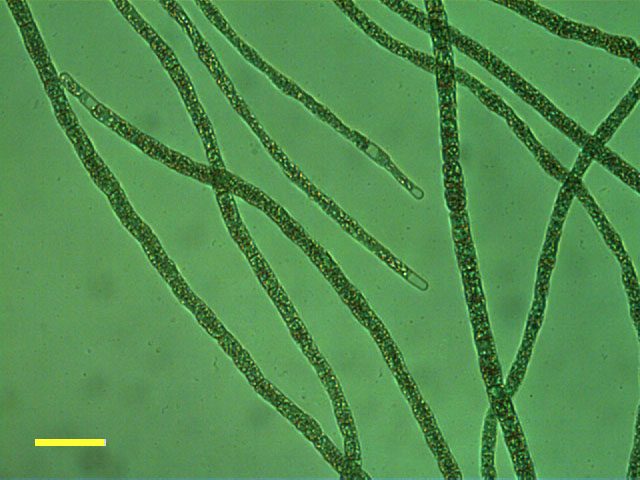
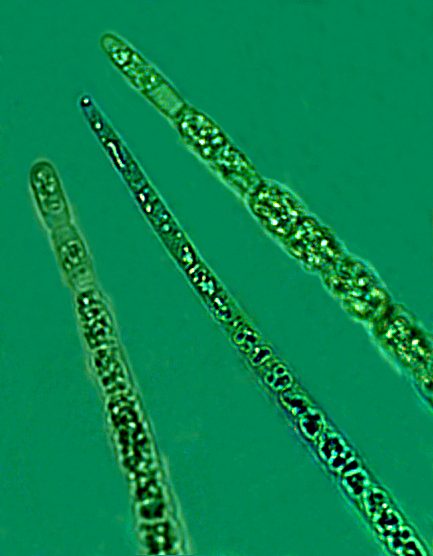
Solitary planktonic , straight or slightly curved, several hundred µm long, 3-4 µm wide, with bluntly rounded or slightly tapered and often colorless end cells; scarcely constricted at the cross walls (Plates 1, 2). Vegetative cells are cylindrical, 1-3 times longer than wide, at the ends of the trichome, up to 6-7 times longer than wide, gradually becoming longer and often reaching 25-30 µm in length; with gas vesicles. Heterocytes solitary, intercalary (between two other cells; never at end of trichome), nearly spherical or ellipsoidal, 2-6 µm wide (median: 3.4 µm) and 2.5-9 µm long (median: 5.30. Akinetes (resting cells) oval, usually separated by vegetative cells from heterocytes on the same trichome, up to 3-14 µm (median: 6.7 µm) wide and 5-23 µm long (median: 10.2 µm), with a yellow or brown envelope. Reproduction by fragmentation of trichomes and by germination of akinetes. The species can be distinguished from the other common nostocalean cyanobacterium, Raphidiopsis (previously Cylindrospermopsis) raciborskii by its end cells. In U. ovalisporum they are thinner than the rest of the trichome cells and partly or completely with a blunt ending (Plate 2), as opposed to the pencil-/needle-shaped ending or a terminal heterocyte in U. raciborskii. Cell diameter is also larger in U. ovalisporum (Plate 3). Another, less common nostocalean cyanobacterium that should be distinguished from U. ovalisporum is Chrysosporum (previously Anabaena) bergii. (Stüken et al. 2009). The distinction is again by end cells (see item for Chrysosporum).
Ecology
Umezakia ovalisporum, a nitrogen-fixing cyanobacterium, invaded Lake Kinneret in 1994 (Pollingher et al. 1998), shortly after the Hula Valley was hydrologically disconnected from Lake Kinneret when Lake Agmon was created (Hambright and Zohary 1998). This disconnection reduced substantially the nitrate load entering Lake Kinneret and created in-lake conditions suitable for the proliferation of nitrogen fixers. Umezakia ovalisporum was the first of several species of nostocalean cyanobacteria never recorded previously that appeared in Lake Kinneret since 1994 and got established in the lake. In September-October 1994 U. ovalisporum formed a massive bloom (Fig. 1). Since then, it is a common component of the Kinneret summer phytoplankton (Fig. 1). It occurs in the plankton only when the lake is stratified, peaking in September-October (Fig. 2). Cell diameter also fluctuates seasonally, having maximal diameter in winter, smallest in summer (Fig. 3). Towards the onset of winter, it forms akinetes (Plate 1) that sink to the sediment and wait for germination till the following summer. This species is usually evenly distributed throughout the epilimnion. In Kinneret it doesn’t form surface films or bundles.
Physiological features
Like other nostocalean species, it fixes atmospheric nitrogen. N-fixation happens in the heterocytes, where anoxic conditions are maintained. It produces the hepatotoxin cylindrospermopsin (Banker et al. 1997; 2000) and hence considered bad for water quality. Cylindrospermopsin production was shown to increase supply of inorganic P by inducing secretion of the enzyme Alkaline Phosphatase by other phytoplankton, a called “enslavement” (Bar Yosef et al. 2010). Potassium deficiency triggers the development of akinetes (Sukenik et al. 2013).
Environmental conditions
Umezakia ovalisporum is adapted to higher ambient water temperatures, indifferent to the ambient Cl- concentrations, tolerates pH levels up to 9.2, beyond which it disappears (Fig. 4) and adapted to lower TP levels (not shown). In lab experiments, A. ovalisporum hardly grew under Na+ lower than 2.5 mM (Bar Yosef thesis, P.9, based on Kaplan et al. 1984. FEBS letters 176:166-168).
Cite this record as: Dr. Tamar Zohary, Dr. Alla Alster. 2 November 2026. Electronic publication. Israel Oceanographic & Limnological Research. https://kinneret-algae-atlas.org/ Searched on —.
Further reading
- Ballot A, Ramm J, Rundberget T, Kaplan-Levy RN, Hadas O, Sukenik A, Wiedner C. 2011. Occurrence of non-toxic Aphanizomenon ovalisporum and Anabaena bergii strains in Lake Kinneret (Israel). J Plankton Res 33:1736-1746.
- Banker R, Carmeli S, Hadas O, Teltsch B, Porat R, Sukenik A. 1997. Identification of cylindrospermopsin in Aphanizomenon ovalisporum (Cyanophyceae) isolated from Lake Kinneret, Israel. J Phycol 33: 613-616.
- Banker R, Teltsch B, Sukenik A, Carmeli S. 2000. 7- Epicylindrospermopsin, a toxic minor metabolite of the cyanobacterium Aphanizomenon ovalisporum from Lake Kinneret, Israel. J Natural Products 63: 387-389.
- Bar‐Yosef Y, Murik O, Sukenik A, Hadas O, Kaplan A. 2012. Multiannual variations in phytoplankton populations: what distinguished the blooms of Aphanizomenon ovalisporum in Lake Kinneret in 2010 from 2009? Environmental Microbiology Reports 4:498-503.
- Bar-Yosef Y, Sukenik A, Hadas O, Viner-Mozzini Y, Kaplan A. 2010. Enslavement in the water body by toxic Aphanizomenon ovalisporum, inducing alkaline phosphatase in phytoplanktons. Current biology 20:1557-61.
- Hadas O. 2014. Microbial processes within the nitrogen cycle. Chap. 22 In: Zohary T, Sukenik A, Berman T, Nishri A. [eds] Lake Kinneret: Ecology and Management, pp 381-396. Springer, Heidelberg.
- Hadas O, Pinkas R, Malinsky‐Rushansky N, Nishri A, Kaplan A, Rimmer A, Sukenik A. 2012. Appearance and establishment of diazotrophic cyanobacteria in Lake Kinneret, Israel. Freshwater Biology, 57:1214-27.
- Hadas O, Pinkas R, Malinsky-Rushansky N, Shalev-Alon G, Delphine E, Berner T, Sukenik A, Kaplan A. 2002. Physiological variables determined under laboratory conditions may explain the bloom of Aphanizomenon ovalisporum in Lake Kinneret. European Journal of Phycology, 37:259-267.
- Hadas O, Pinkas R, Vardi A, Kaplan A, Delphin E, Sukenik A. 1999. Limnological aspects of Aphanizomenon ovalisporum bloom in Lake Kinneret, Israel. J Plankton Res 21: 1439-1453.
- Hadas O, Kaplan A, Sukenik A. 2015. Long-term changes in cyanobacteria populations in Lake Kinneret (Sea of Galilee), Israel: an eco-physiological outlook. Life 5:418-31.
- Hambright KD, Zohary T. 1998. Lakes Hula and Agmon: destruction and creation of wetland ecosystems in northern Israel. Wetlands Ecol Manag 6: 83-89.
- Hambright KD, Zohary T, Easton J, Azoulay B, Fishbein T. 2001. Effects of zooplankton grazing and nutrients on the bloom-forming, N₂-fixing cyanobacterium Aphanizomenon in Lake Kinneret. J Plankton Res 23:165–174.
- Kaplan-Levy RN, Hadas O, Sukenik A. 2015. Deciphering the mechanisms against oxidative stress in developing and mature akinetes of the cyanobacterium Aphanizomenon ovalisporum. Microbiology 161:1485-1495.
- McGregor GB, Sendall BC, Niiyama Y, Tuji A, Willis A. 2023. Chrysosporum ovalisporum is synonymous with the true‐branching cyanobacterium Umezakia natans (Nostocales/Aphanizomenonaceae). J Phycol 59:326-41.
- Pollingher U, Hadas O, Yacobi YZ, Zohary T, Berman T. 1998. Aphanizomenon ovalisporum (Forti) in Lake Kinneret (Israel). J Plankton Res 20:1321-1339.
- Shalev-Malul G, Lieman-Hurwitz J, Viner-Mozzini Y, Sukenik A, Gaathon A, Lebendiker M, Kaplan A. 2008. An AbrB-like protein might be involved in the regulation of cylindrospermopsin production by Aphanizomenon ovalisporum. Environm Microbiol 10:988–999.
- Shalev-Alon G, Sukenik A, Livne O, Kaplan A. 2002. A novel gene ecoding amidinotranseerase in the cylindrospermopsin producing cyanobacterium Aphanizomenon ovalisporum. FEMS Microbiol Letters 209: 87-91.
- Stüken A, Campbell RJ, Quesada, A, Sukenik A, Dadheech PK, Wiedner C. 2009. Genetic and morphologic characterisation of four putative cylindrospermopsin producing species of the cyanobacterial genera Anabaena and Aphanizomenon. J Plankton Res 31: 465–480.
- Sukenik A, Beardall J, Hadas O. 2007. Photosynthetic characterization of developing and mature akinetes of Aphanizomenon ovalisporum (Cyanoprokaryota). J Phycol 43:780-788.
- Sukenik A. Hadas O, Kaplan A. 2014. Cyanobacteria. Chap. 12 In: Zohary T, Sukenik A, Berman T, Nishri A. [eds] Lake Kinneret: Ecology and Management, pp. 213-226. Springer, Heidelberg.
- Sukenik A, Hadas Stojkovic S, Malinsky-Rushansky N, Viner-Motzini Y, Bearall J. 2009. Fluorescence approaches reveal variations in cellular composition during formation of akinetes in the cyanobacterium Aphanizomenon ovalisporum. Eur J Phycol 44: 309-317.
- Sukenik A, Kaplan‐Levy RN, Viner‐Mozzini Y, Quesada A, Hadas O. 2013. Potassium deficiency triggers the development of dormant cells (akinetes) in Aphanizomenon ovalisporum (Nostocales, Cyanoprokaryota). J Phycol 49:580-7.
- Zohary T, Yacobi YZ, Alster A, Fishbein T, Lippman S, Tibor G. 2014. Phytoplankton. Chap. 10 In: Zohary T, Sukenik A, Berman T, Nishri A. [eds] Lake Kinneret: Ecology and Management, pp. 161-190. Springer, Heidelberg.