- Phylum
- Dinoflagellata
- Class
- Dinophyceae
- Order
- Gonyaulacales
- Habitat
- plankton
- Organization
- flagellated single cells
- Color
- yellow to golden-brown
- Cell shape
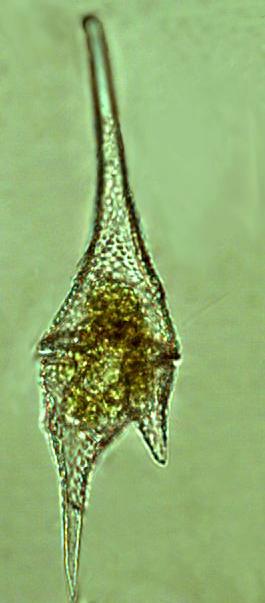
- a spheroid from which 2-4 horns of different lengths extend
- Cell diameter (D)
- 30-50 μm wide
- Cell length (L)
- 165-260 μm long (literature values)
- Cell biovolume
- 70,000 μm3 (literature value, we do not routinely measure this species)
Morphological features
The genus Ceratium has a distinct shape of a central body from which several horns extend to opposite directions (Plate 1), this shape can’t be mistaken with any other genus occurring in Lake Kinneret. Cells of C. furcoides are slender, longer than wide, strongly dorsiventrally flattened. gradually tapers into a long apical horn without shoulders. broad and short, drawn out into 2 (occasionally 1 or 3) horns of different lengths. Nucleus prominent in epicone. Cysts are smooth-walled, triangular, with one narrow horn extending from each corner. Ceratium furcoides is narrower and slenderer than the more common C. hirundinella.
Ecology
Historically this species was identified as Ceratium hirundinella var. furcoides and counted as C. hirundinella. Therefore, there are no ecological data specific for it.
Cite this record as: Dr. Tamar Zohary, Dr. Alla Alster. 7 August 2026. Electronic publication. Israel Oceanographic & Limnological Research. https://kinneret-algae-atlas.org/ Searched on —.