- Phylum
- Cyanobacteriophyta
- Class
- Cyanophyceae
- Order
- Chroococcales
- Habitat
- planktonic
- Distinctive features
- colonies of spherical cells organized in radiating uniseriate rows extending from the center. No cyanotoxins are known for this species.
- Organization
- colonies
- Color
- blue-green
- Cell shape
- sphere
- Colony shape
- spherical (more or less)
- Cell diameter (D)
- 1-3.7 µm; median: 2 μm; N=609
- Cell biovolume
- 0.5 – 25 μm3, median: 4 μm3; N=609
- Biovolume equation
- Sphere V, μm3 = 4/3 π (D/2)3
- Colony diameter
- up to 70 µm
- Cells per colony
- 40-100 (600)
Morphological features
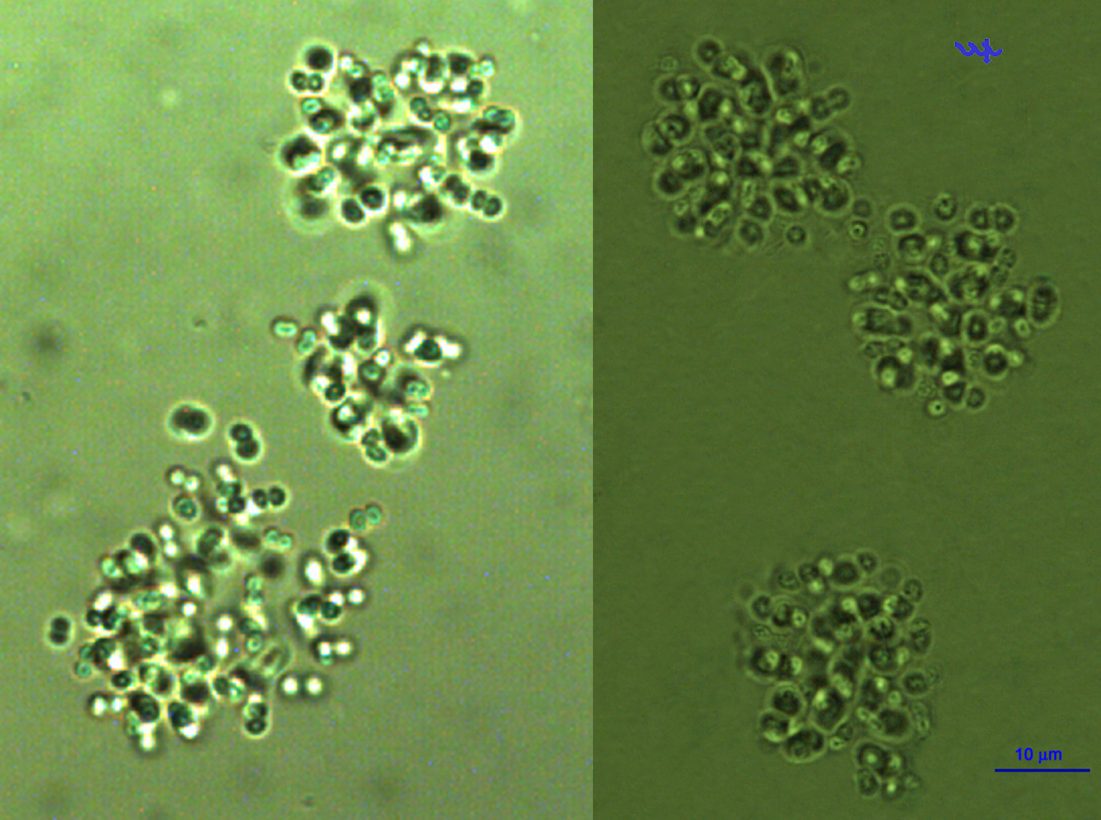
Colonies are made of small (~2 µm diameter) more or less spherical or slightly elongate cells, organized in radiating uniseriate rows extending from the center to all directions, embedded in colorless mucilage (Plate 1). Cells with gas vesicles. Can be distinguished from Microcystis spp. by the smaller cell size and organization in radiating rows. Cell size varies only slightly, OK not to measure cell size routinely, to use a median value instead.
Ecology
Radiocystis geminata has always been a member of the Kinneret plankton, although there were periods during which it was nearly absent (e,g, 1993-1995; 2005-2006; 2011-2014) but then it returned (Fig. 1). When present, it is often very abundant, with hundreds of colonies made of thousands of cells per mL (Fig. 1). Peak abundance is in summer, from July to September, while in winter the species is practically absent (Fig. 2). The number of cells in a colony shows a weak seasonal cycle, with larger colonies in winter and smaller in summer (Fig. 2). The variation in cell size is minor (Fig. 2).
Environmental conditions
Abundance increases with water temperature. Indifferent to salinity at the range occurring in Kinneret. Most abundant when pH ranges 8.5-9, 100-120 mg CaCO3 mL-1 (not shown).
Cite this record as: Dr. Tamar Zohary, Dr. Alla Alster. 7 August 2026. Electronic publication. Israel Oceanographic & Limnological Research. https://kinneret-algae-atlas.org/ Searched on —.