Cox (1996) reference plates
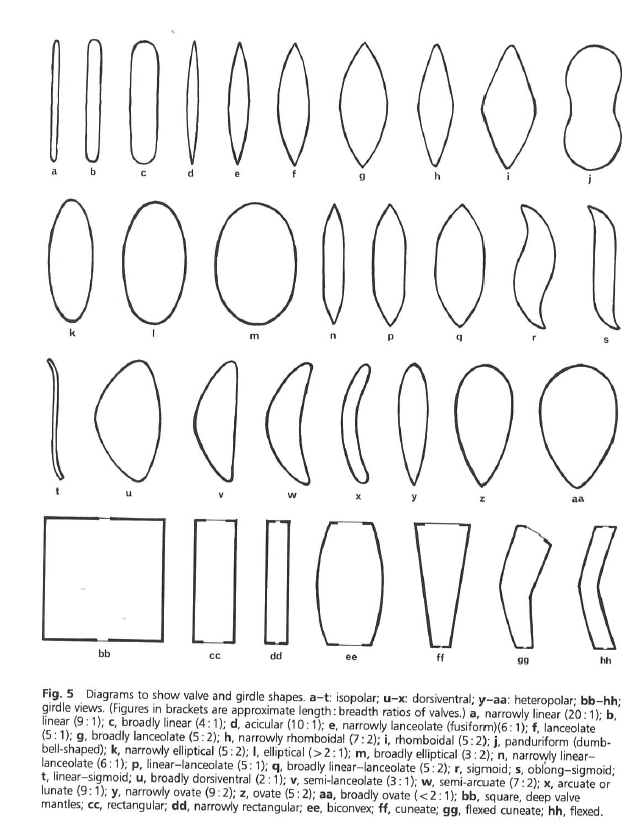
A
- acicular
- needle-shaped
- acute
- sharp. Acute angle: <90 degrees
- akinete
- in cyanobacteriophyta: a type of spore formed by the transformation of a vegetative cell into a thick-walled resting cell, containing concentrated food material
- alkalibiontic
- occurring only in alkaline water at pH > 8.5
- alkalinity
- mg CaCO₃ L⁻¹
- alkaliphilous
- occurring at pH around 7, best development at pH > 7
- amoeboid
- amoeba like
- antapex
- the point opposite to the tip of the cell on its other end
- antapical
- opposite to the tip of the cell on its other end
- anterior
- situated at the front side, opposite of posterior
- apex (plural: apices)
- tip of a cell (in species that have one or more attenuated endings)
- apical axis
- in diatoms: axis linking the two poles of a valve
- apiculate
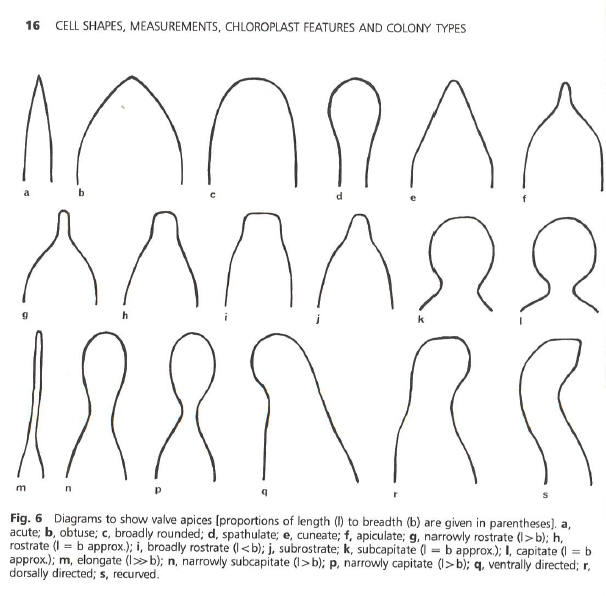
- terminating in a short, sharp, flexible point. In diatoms: having a short broad tip see Cox (1996) Plate 2
- aplanospores
- non-motile spores formed asexually within the parent cell, having no flagella
- arcuate
- see Cox (1996) Plate 1
- areola (plural: areolae)
- a regular, repeated perforation through the siliceous layer on the valve of a diatom cell
- athecate
- in dinoflagellates: ‘naked’, not having thecae, not being enclosed in a shell of cellulose plates
- attenuated
- long, narrow and sometimes tapering
- autogamy
- non-sexual reproduction, self-fertilization or conjugation in an individual organism by division of its nucleus into two parts that in turn reunite to form a zygote
- auxospore
- large cell resulting from sexual reproduction or autogamy. In diatoms, they lack the rigid valves, instead they are covered by delicate siliceous scales or bands
- axial
- along the axis
B
- benthic (benthonic)
- occurring on the bottom of a water body
- bilateral symmetry
- symmetry about a single middle line
- broad linear
- see Cox (1996) Plate 1
C
- capitate
- having a part that is enlarged and rounded (like a head) see Cox (1996) Plate 2
- caudus
- ‘tail’ of euglenophytes
- cingulum (plural: cingula)
- portion of the diatom girdle associated with a single valve. In dinoflagellates: a transverse groove that encircles the cell and holds the transverse flagellum in place.
- clathrate
- forming a net. Refers to mucilaginous colonies of cyanobacteria and a few chlorophytes which include extensive internal “holes” or spaces that are in contact with the external environment.
- conductivity
- specific conductance, μS cm⁻¹
- conjugation
- a form of sexual reproduction where neither gamete is flagellated. This type of reproduction, typical of the Zygnematalean (conjugating) green algae, cells attach to each other so that the gametes can fuse.
- costa (Plural: costae)
- rib-like longitudinal cell wall thickening
D
- DO
- dissolved oxygen
- DOC
- dissolved organic carbon
- DON
- dissolved organic nitrogen
- DOP
- dissolved organic phosphorus
- dorsal
- back side, opposite of ventral
- dorsiventral
- in diatoms: a cell with different curvature to its two sides connecting the apices see Cox (1996) Plate 2
E
- epilithic
- occurring on rocks and pebbles
- epipelic
- occurring on mud
- epiphytic
- occurring on aquatic plants
- epitheca
- in dinoflagellates: the upper theca of the dinoflagellate cellulose shell, which together with the hypotheca makes a full cell covering.
- eulittoral zone
- the lake region between maximum and minimum water level.
- eyespot
- light-sensitive, typically red-colored (carotenoid pigments) spot or organelle in algal cells
F
- fibula (plural: fibulae)
- in diatoms: a bridge of silica between portions of the valve on either side of the raphe
- flagellum (plural: flagella)
- long, thread-like organelle that projects out of the cell and functions in motility
- frustule
- the cell wall of a diatom cell, composed of silica, comprised of two valves and a series of linking bands, the girdle
- fusiform
- elongated shape that is widest in the middle and tapering towards the ends. Spindle shape. Like an American football
G
- gametangium (plural: gametangia)
- a cell containing the gametes
- gamete
- sex cell
- girdle
- the region in a diatom frustule (shell) where the two valves overlap
- girdle view
- in diatoms, the way the cell looks under the microscope when examined looking at the girdle of the cell (as opposed to the valve view, i.e. looking at the valve side of the cell)
- gullet
- a longitudinal depression in the upper part of a cryptophyte, chrysophyte or euglenophyte cell from which a flagellum or flagella emerge
H
- haptonema
- a thread-like appendage between the 2 flagella of Haptophytes
- heterocyte
- a thick-walled, non-pigmented cell of nostocalean cyanobacteriophyta that is different from adjacent vegetative cells and where N-fixation takes place.
- heteropolar
- having different poles. In diatoms: with apices of differing size and/or shape
- hyaline
- colorless, translucent, clear
- hypotheca
- in dinoflagellates: the lower theca of the dinoflagellate cellulose shell, which together with the epitheca makes a full cell covering
I
- intercalary cell
- located between two other cells in a filament
- isogamous (isogamy)
- sexual reproduction in which two types of gametes are morphologically indistinguishable, although functionally they are different.
- isopolar
- having the same poles. In diatoms: with apices of the same size and shape
- isthmus
- in desmids: the narrow mid-region of the cell connecting the two semicells; the nucleus is located in this mid-region
L
- lamellate
- composed of thin layers or plates. Also used to refer to successive layers of mucilage
- laminate
- reefers to layers or plates overlying one another
- lanceolate
- lance-shaped, with the broadest part usually about 1/3 of the distance from base and usually tapering towards each end. see Cox (1996) Plate 1
- linear
- see Cox (1996) Plate 1
- linear-lanceolate
- see Cox (1996) Plate 1
- lorica
- a protective case containing a naked (non-walled) cell
- lunate
- shape of a moon in its first quarter. see Cox (1996) Plate 1
M
- mantle
- see valve mantle
O
- oligohalobious
- form developing in freshwater
- oligohalobious-indifferent
- form developing usually in freshwater but can tolerate small to moderate amounts of salts
- oligosaprobic
- form developing optimally in slightly polluted water
- oogamy (oogamous)
- sexual reproduction in which there is a fusion of a smaller flagellated male gamete (e.g. spermatozoid) with a larger, non-flagellated female gamete (e.g. egg or oogonium)
- oogonium (plural: oogonia)
- large, single-celled female gametangium that may produce one or more eggs.
P
- papilla
- (plural: papillae) protuberance or swelling
- paramylon
- a carbohydrate stored in euglenophytes in ‘paramylon bodies’
- parietal
- positioned by the cell wall
- pellicle
- in euglenoids, the outer proteinaceous cell surface layer (or peripheral protoplasmic layer), often in a spiral arrangement
- pentangular
- having 5 sides
- periphytic
- occurring on the bottom a water bodies and on submerged objects (biotic and abiotic); can be attached or free
- pH-indifferent
- best development around pH 7
- posterior
- situated at the rear or back side, opposite of anterior
- process
- a part that naturally grows on or sticks out on an organism
- protoplast
- the living material inside a cell. In thecate dinoflagellates the protoplasts are membrane-bound and can emerge out of their thecae
- puncta (singular: punctum)
- minute depressions on the diatom valve or the desmid cell wall
- punctate
- ornamented with dots (=puncta)
- pyrenoid
- organelle, often spherical, associated with the chloroplast containing the enzyme Rubisco
- pyriform
- pear-shaped
R
- radial symmetry
- symmetry resembling that of a pie, where several cutting planes produce roughly identical pieces. There is no left or right side, only top (dorsal) and bottom (ventral) sides
- raphe
- in diatoms, a pair of slit-like structures in one or both valves associated with the gliding movement
- reniform
- kidney shaped
- reticulate
- net-shaped (with holes)
- retuse
- having a rounded end but with slight indentation; like a retuse leaf
- rostrate
- see Cox (1996) Plate 2
S
- scalariform conjugation
- ladder-like; in members of conjugatophycea a type of conjugation where the conjugation tube forms between two parallel filaments
- septum (plural: septa)
- in diatoms: cross-partitioning on a girdle element projecting into or dividing a cell into chambers
- serrulate
- finely serrated. Having a finely notched edge like the teeth of a saw
- sheath
- covering or envelope surrounding the cell wall, usually mucilaginous
- sinus
- in desmids: the median incision dividing the desmid cell into two semicells
- spinule(s)
- minute spine or thorn-like projection(s)
- stellate
- star-shaped
- sternum
- in diatoms: a hyaline region, without striae, running a long the long axis of a valve in araphid diatoms
- stigma
- see: eyespot
- stria (plural: striae)
- stripe(s), line of pores on the diatom valve
- subaerophytic
- from terrestrial habitats which receive occasional or partial moisture, such as dripping rocks
- subcapitate
- see Cox (1996) Plate 2
- subrostrate
- see Cox (1996) Plate 2
- sulcus
- in dinoflagellates: a longitudinal groove in the ventral face of the cell, in hypotheca/hypocone that may extend into the epitheca/epicone; hold the longitudinal whiplash flagellum
- suture
- Line or groove, especially in desmids, marking the limits between adjacent semicells. In filamentous Zygnematales: groove around zygospore. In armored dinoflagellates: groove between the plates
T
- tapering
- narrowing, ending in a point
- theca (Plural: thecae)
- in dinoflagellates: a cell covering made of cellulose plates. Usually each cell has 2 thecae (an epi-theca and a hypo-theca), which together fully encase the cell
- thecate
- in dinoflagellates: having thecae, being enclosed in a shell of cellulose plates which makes the cell look ‘armored’
- transapical axis
- in diatoms: axis linking the mid-points of opposing valve margins, intersecting the middle of the apical axis
- transverse
- passing through a hyperbola’s foci
- trichocyst
- in cryptophytes, dinoflagellates and raphidophytes: membrane surrounded organelle lying beneath the cell surface, which ejects threads of mucilage on stimulation
- trichome
- in cyanobacteriophyta: a filament, but without the sheath. The term is synonymous with filament for forms which never possess a sheath, but for those which do, the filament consists of a trichome and a sheath
- truncate
- cut off, trimmed, as opposed to being rounded or pointed.
- tychoplanktonic
- species that are predominantly planktonic but are capable of prolonged survival on or in sediments
U
- undulate (adj)
- with a wavy appearance, edge or marking
- undulation
- a curving form or outline, especially one in a series such as a wave
V
- valve
- one of two halves of the diatom silicaceous shell (=frustule). The two valves usually have the same shape, but since one fits into the other as in a petri dish, they are of different size
- valve face
- the round part of the valve
- valve mantle
- the marginal part of the valve, differentiated by slope and/or structure
- valve margin
- the edge of the valve where the cingulum begins
- valve view
- in diatoms, the way the cell looks under the microscope when examined looking at the valve face of the cell (as opposed to the girdle view, i.e. looking at the girdle face of the cell)
- ventral
- front side, opposite of dorsal
- verruca (Plural: verrucae)
- wart(s) or spiny projection(s)
- verrucose
- covered with warty or spiny projections
Z
- zoosporangium
- cell producing zoospores
- zoospore
- motile asexual spore
- zygospore
- thick-walled resting spore formed sexually by the fusion of two gametes