- Phylum
- Cyanobacteriophyta
- Class
- Cyanophyceae
- Order
- Chroococcales
- Habitat
- planktonic, pelagic
- Distinctive features
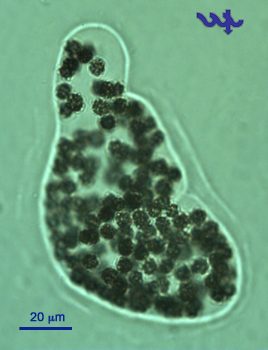
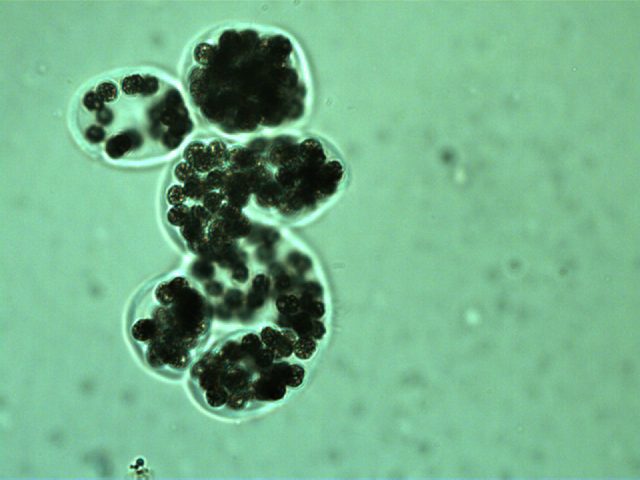
- The largest-cell species of the chroococcalean cyanobacteria in Lake Kinneret. Colonies of spherical cells embedded in mucilage that has a distinct border. Common but never dominant.
- Organization
- colonial
- Color
- dark brown
- Cell shape
- sphere
- Colony shape
- spherical, elongate or lobate
- Cell diameter (D)
- 3.4 – 7.5 μm, median: 5.5 μm (N=402)
- Cell biovolume
- 20 – 220 μm3, median: 90 μm3
- Biovolume equation
- Sphere, V= 4/3 π (D/2)3
- Colony diameter
- ~ 100 µm
- Cells per colony
- 10-300
Morphological features
Colonies initially spherical, later becoming elongate and intensely lobate, often with distinct holes (), sometimes composed of sub-colonies. Cells arranged randomly, rarely densely, in young colonies near the colony surface. The cells are embedded in colorless smooth, firm distinctly delimited mucilage with a refractive outline. The gelatinous margin extends 3-6 µm beyond the cell aggregations. Cells are spherical with distinct aerotopes, 4.0-7.5 µm in diameter (McGregor et al. 2007).
Ecology
Microcystis wesenbergii is one of the common species of cyanobacteria occurring in Lake Kinneret (Fig. 1), but it was never dominant and never recorded to form a bloom (although it did form a bloom in Agmon-Hula in summer 2020). The species was not counted at all prior to 1998. It was more abundant during 1998-2009 than later (Fig. 1). Since July 2024 and until writing this item (July 2026) it was not found at all in Kinneret phytoplankton samples (data not shown). The species is more abundant from March to August, less abundant in winter (Fig. 2a). Colony size shows the opposite annual cycle, with more cells per colony in winter, less in summer (Fig. 2b). Cell volume fluctuates within a small amplitude around the multiannual median of 90 µm3 (Fig. 2c).
Physiological features
Like other species of Microcystis, M. wesenbergii is known to produce toxins. The toxicity of Kinneret M. wesenbergii was never tested because it doesn’t form blooms and we do not have a culture of it, it was impossible to collect for testing sufficient biomass of it alone, not contaminated by the more abundant toxin-producing M. flos-aquae and M. aeroginosa.
Environmental conditions
M. wesenbergii abundance is independent of water temperature, mixing depth, euphotic zone depth, and calcium concentrations. Abundance increases with pH, from pH 8 till about pH 9.2, and with , till about 0.3 mg L-1. All abundance peaks occurred at NH4 < 25 µg L-1 and organic-N around 0.4 mg L-1. Colony size (=number of cells per colony) declined with increasing temperature, increased with calcium and alkalinity and was independent of nitrate, ammonium and DON concentrations.
Cite this record as: Dr. Tamar Zohary, Dr. Alla Alster. 22 August 2026. Electronic publication. Israel Oceanographic & Limnological Research. https://kinneret-algae-atlas.org/ Searched on —.
Further reading
- Komárek J, Anagnostidis K. 1999. Cyanoprokaryota. 1. Chroococcales. In: Süßwasserflora von Mitteleuropa. Begründet von A. Pascher. Band 19/1. (Ettl H, Gärtner G, Heynig H, Mollenhauer D, Eds), pp. 1-548. Heidelberg & Berlin: Spektrum, Akademischer Verlag.
- McGregor G, Fabbro LD, Lobegeiger JS. 2007. Freshwater planktic Chroococcales (Cyanoprokaryota) from North-Eastern Australia: a morphological evaluation. Nova Hedwigia 84(3/4): 299-331.