- Phylum
- Cyanobacteriophyta
- Class
- Cyanophyceae
- Order
- Chroococcales
- Habitat
- planktonic
- Distinctive features
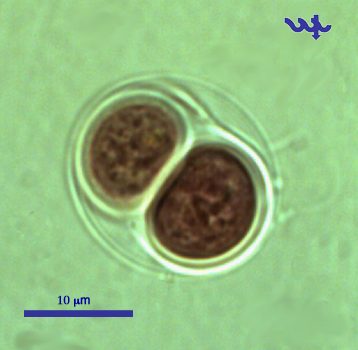
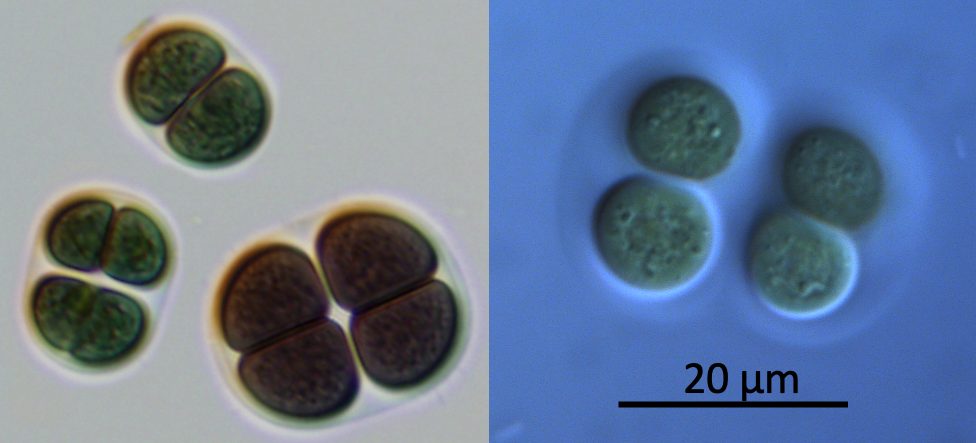
- single strongly pigmented cells or more often two cells, or occasionally small colonies of few cells in distinct, thick colorless envelope(s).
- Organization
- single cells or colonies of 2 (most common) to 8 cells
- Color
- blue-green
- Cell shape
- sphere
- Colony shape
- spherical
- Cell diameter (D)
- 4 – 13 μm, median: 6.2 μm (N=502). Cell diameter varies significantly over an annual cycle, making it necessary to measure it routinely.
- Cell biovolume
- 40 – 200 μm3. Larger cell size in winter, smaller in summer (see Fig. 2).
- Biovolume equation
- Sphere V, μm3 = 4/3 π (D/2)3.
Morphological features
Individual spherical cells are surrounded by . After division the original sheath remains around each new cell but an additional sheath envelopes both cells, now hemispherical in their shape, that remain attached (Plates 1). The cells are strongly colored, the envelopes are colorless but distinct (Plate 2). Chroococcus turgidus and Chroococcus minutus are difficult to tell apart. The only easy to notice difference is that the envelopes of C. turgidus are laminated (layered), whereas that of C. minutus typically show no layering. On average, C. minutus cells are smaller, but both species show large size variation and the sizes overlap.
Ecology
An alanlyst effect is apparent in the long-term record of C. minutus and C. turgidus shown in Fig. 1. In particular, it is evident that Analyst 5 (1996-2012) counted more C. minutus whereas Analyst 6 (2013-2020) counted more C. turgidus, probably due to different taxon names given to the same organisms. Chroococcus minutus / turgidus has always been common in lake Kinneret, with long periods of thousands of (mostly 2-celled) colonies mL-1 (Fig. 1). Prior to the decline of Peridinium gatunense and appearance of nostocalean cyanobacteria in the mid 1990s Chroococcus was the most abundant Kinneret cyanobacterial taxon. Like several other Kinneret species, cells are smaller in summer, larger in winter (Fig. 2).
Environmental conditions
Chroococcus turgidus is more abundant at temperature > 22 C. It occurs at all chloride concentrations.
Cite this record as: Dr. Tamar Zohary, Dr. Alla Alster. 7 August 2026. Electronic publication. Israel Oceanographic & Limnological Research. https://kinneret-algae-atlas.org/ Searched on —.