- Phylum
- Cyanobacteriophyta
- Class
- Cyanophyceae
- Order
- Nostocales
- Habitat
- benthic (), littoral
- Distinctive features
- half pompon-shaped hemispherical epiphytic colonies made of many filaments embedded in firm mucilage.
- Organization
- colonial
- Color
- dark khaki brown
- Cell shape
- cylinder
- Colony shape
- half sphere, made of an aggregate of filaments
- Cell diameter (D)
- 4-7 μm
- Cell length (L)
- 4-12 μm
- Cell biovolume
- 100 – 350 μm3
- Biovolume equation
- Cylinder, V, μm3 = π L (D/2)2
- Filament length
- hundreds of microns
- Colony diameter
- 0.1–1.5 cm
Morphological features
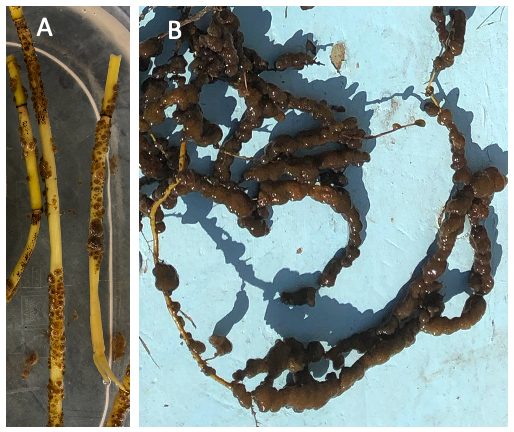
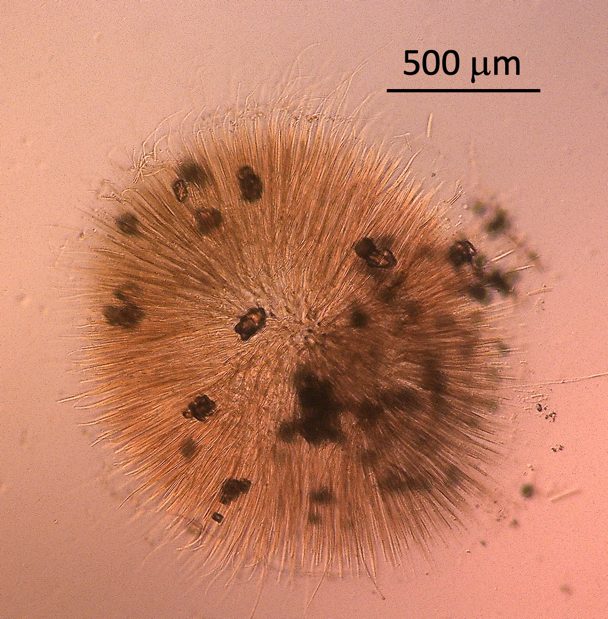
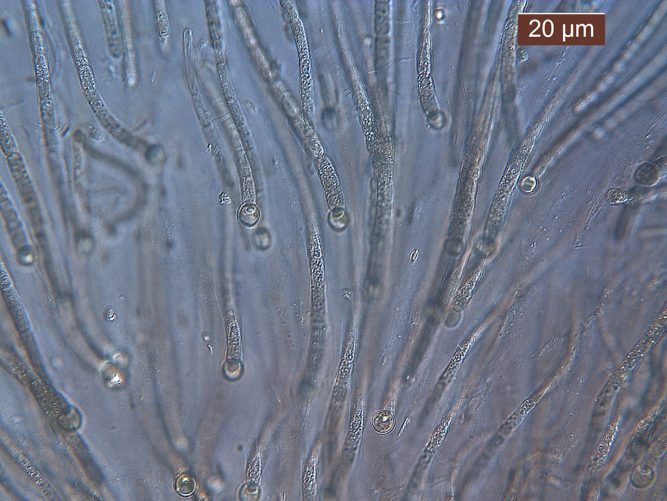
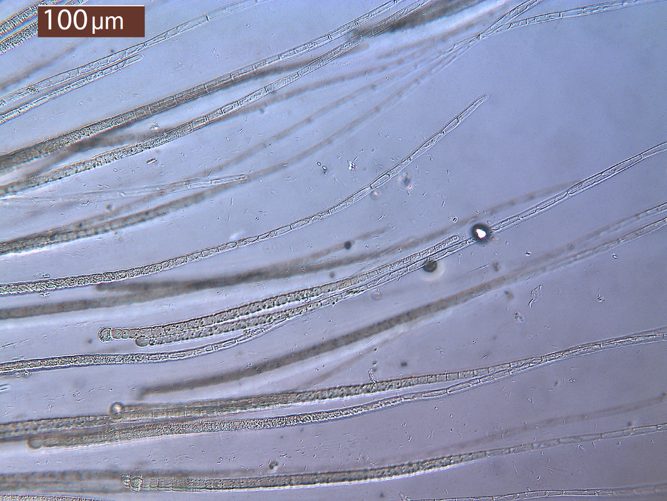
Hemispherical colonies that are attached to plant material, (usually branches of Phragmites australis, but not exclusively) several mm or even cm in diameter, i.e. large enough to be seen with a naked eye (Plate 1). The colonies are khaki-brown, hard and slimy to the touch, they peel off the stems with slight pressure. Young colonies distant from other ones on the same stem are mostly perfect hemispheres (Plate 1A); when in masses the colonies form a continuous with rounded margins (Plate 1B). Colonies are made of thin, long cylindrical filaments, embedded in firm mucilage. The filaments adhere to a common center, giving the colony a shape of half a pompon (Plate 2). The individual filaments, also called , begin with a spherical located towards the inside of the colony (Plate 3); the apical cell is conical and ends in a hair that extends beyond the (Plate 4). are cylindrical, smooth, colorless and are placed next to the basal heterocyst.
Ecology
With climate change, the relative importance of benthic cyanobacteria is mounting. With increased amplitude of water level fluctuations in Lake Kinneret, littoral zone habitats are changing as well as their biota (Zohary and Gasith 2025). Following a rapid rise of lake water level due to a high rainfall winter, in summer 2020 Gloeotrichia pisum appeared as an abundant epiphyte on recently inundated stems of Phragmites australis. This was the first time this species was recorded to occur in Israel (Lang-Yona et al. 2023).
Genomic community composition analysis revealed that G. pisum colonies host a diverse microbial community of microalgae, cyanobacteriophyta, bacteria, and archaea with a conserved and characteristic taxonomic composition.
Genomic community composition analysis revealed that G. pisum colonies host a diverse microbial community of microalgae, cyanobacteriophyta, bacteria, and archaea with a conserved and characteristic taxonomic composition.
Physiological features
Fixes atmospheric nitrogen. High phycoerythrin content provides a brownish color and supports growth at low light levels. Found negative in tests for presence of genes for biosynthesis of the toxins anatoxin, cylindrospermopsin and microcystins.
Environmental conditions
Epiphytic on inundated branches of Phragmites australis. Found also on adventitious roots of Tamarix sp. and other hard surfaces.
Cite this record as: Dr. Tamar Zohary, Dr. Alla Alster. 6 August 2026. Electronic publication. Israel Oceanographic & Limnological Research. https://kinneret-algae-atlas.org/ Searched on —.
Further reading
- Lang-Yona N, Alster A, Cummings D, Freiman Z, Kaplan-Levy R, Lupu A, Malinsky-Rushansky N, Ninio S, Sukenik A, Viner-Mozzini Y, Zohary, T. 2022. Gloeotrichia pisum in Lake Kinneret: a successful epiphytic cyanobacterium. Journal of Phycology 59: 97-110. DOI: 10.1111/jpy.13301.
- Zohary T, Gasith A. 2025. Opinion: Climate change-driven water level regimes regulate lakeshore structure and function. Inland Waters 15: 2480886. https://doi.org/10.1080/20442041.2025.2480886.