- Phylum
- Bacillariophyta
- Class
- Melosirophyceae
- Order
- Melosirales
- Habitat
- plankton, benthos
- Distinctive features
- filamentous, sharp spines at end cell, abundant during winter holomixis
- Organization
- filamentous
- Color
- golden-brown
- Cell shape
- cylinder
- Colony shape
- filament, made of a chain of cylindrical cells
- Cell diameter (D)
- 9-16 µm (median 12.6) (N=241)
- Cell length (L)
- 27-37 µm (median 31 µm)
- Cell biovolume
- 2000-9000 μm3, median: 4000 μm3
- Biovolume equation
- Cylinder, V = 2 π L (D/2)2. Or: regression eqn. based on >500 measurements of both D and L with V computed for a cylinder: V=50.538D1.7197)
- Filament length
- 150-900 µm (median: 400 µm). Longer filaments in winter, shorter in summer (see Fig. 2b)
- Cells per filament
- 5-28 (median: 14)
- Indicator species
- , , to mesosaprobic, inhabits eutrophic waters. The variety angustissima is an indicator of greater water eutrophication. It is oligohalobious-indifferent, alkaliphilous, mesosaprobic (Ehrlich 1995).
Morphological features
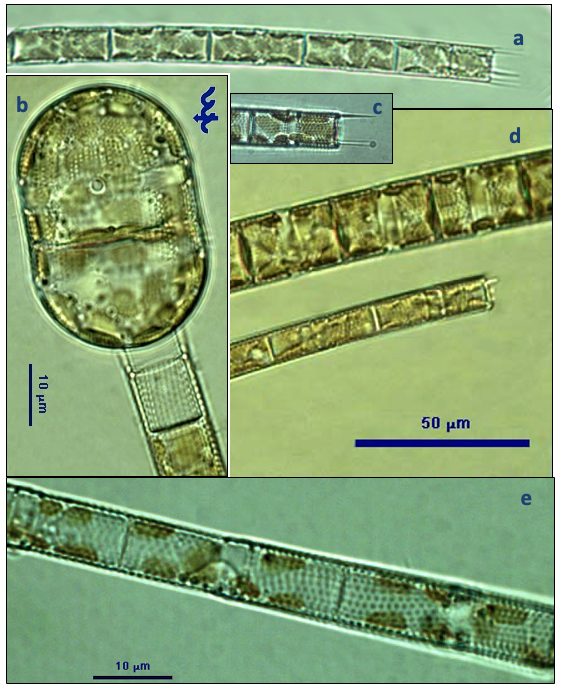
A filamentous centric diatom, with cylinder-shaped cells, interconnected by means of delicate spines in one cell that interlock into matching grooves in the neighboring cell. The spines can be seen in end-cells (Plate 1a, c) and are diagnostic of the species. Each cell is made of two that fit into each other like the two parts of a petri dish. In lake Kinneret, cell diameter ranges 9-16 µm (median 11.5), cell length 27-37 µm (median 31 µm); the filaments are straight, with 5-28 cells per filament. The valves are decorated with straight or slightly curved rows of areoles (pores, perforations), 9-15 such rows (= ) per 10 µm (Plate 1b, c, e). Straight and curved striae may occur together on adjacent cells of a single filament or even in one cell. The areoles vary greatly in size.
Under light microscope A. granulata are usually seen in , showing the long, filaments (Plate 1). In Lake Kinneret the filaments are always straight, the curled morphotype is absent. The species is known to be polymorphic regarding size, diameter/length ratio and striation. Strongly silicified forms with coarse, irregularly spaced areoles are termed Aulacoseira (Melosira) granulata var. valida (Hustedt) Simonsen 1979. In Lake Kinneret intermediate forms between this variety and the nominate are frequent (Ehrlich 1995).
Asexual vegetative cell division is the ordinary way of Aulacoseira granulata reproduction. Cell division results in progressively smaller frustules until a specific minimum valve diameter is attained. A reestablishment of the maximum size is then achieved by sexual reproduction with (zygote) formation (Plate 1b; O’Farrel et al. 2001). The huge auxospore of A. granulata “resets” the cell size for the next growing season. In Lake Kinneret Aulacoseira granulata auxospores were seen rarely.
A variety of the species found in Lake Kinneret is Aulacoseira granulata var. angustissima (O.F. Müller) Simonsen 1979 (Plate 1d). This variety differs from the nominate by its much narrower cells. Cell diameter < 4 µm (as opposed to 9-16 µm in the nominate variety), cell length 12 – 25 µm, diameter/length ratio is about 1/5 – 1/8 (Ehrlich 1995).
Under light microscope A. granulata are usually seen in , showing the long, filaments (Plate 1). In Lake Kinneret the filaments are always straight, the curled morphotype is absent. The species is known to be polymorphic regarding size, diameter/length ratio and striation. Strongly silicified forms with coarse, irregularly spaced areoles are termed Aulacoseira (Melosira) granulata var. valida (Hustedt) Simonsen 1979. In Lake Kinneret intermediate forms between this variety and the nominate are frequent (Ehrlich 1995).
Asexual vegetative cell division is the ordinary way of Aulacoseira granulata reproduction. Cell division results in progressively smaller frustules until a specific minimum valve diameter is attained. A reestablishment of the maximum size is then achieved by sexual reproduction with (zygote) formation (Plate 1b; O’Farrel et al. 2001). The huge auxospore of A. granulata “resets” the cell size for the next growing season. In Lake Kinneret Aulacoseira granulata auxospores were seen rarely.
A variety of the species found in Lake Kinneret is Aulacoseira granulata var. angustissima (O.F. Müller) Simonsen 1979 (Plate 1d). This variety differs from the nominate by its much narrower cells. Cell diameter < 4 µm (as opposed to 9-16 µm in the nominate variety), cell length 12 – 25 µm, diameter/length ratio is about 1/5 – 1/8 (Ehrlich 1995).
Ecology
The ecology of A. granulata is strongly tied to mixing, sinking, filament morphology and seasonal physical conditions. It is a planktonic, filament-forming diatom characteristic of well-mixed, relatively nutrient-rich waters. Its heavy silicified frustules make individual filaments relatively dense, in calm water they sink quicker than other phytoplankton and depend on turbulence to remain suspended in the water column. This explains why in stratified lakes like Kinneret Aulacoseira species occur during periods of strong vertical mixing.
The species is one of the most common diatoms of Lake Kinneret, with peak abundance during winter holomixis when it occupies the entire 40 m water column. Major A. granulata blooms were recorded 1988; 1999; 2001 (Fig. 1). Those blooms always occur in Jan-Feb; at other times of the year it is occasionally present at low background levels (Fig. 2 c). A. granulata is the only species in Lake Kinneret besides Peridinium gatunense that ever-reaches depth-integrated biomass exceeding 100 g m-2 and on 3 occasions > 250 g m-2 (Fig. 1). In recent years its abundance has declined.
The strongly silicified forms of Lake Kinneret A. granulata require optimal turbulence to maintain them in the fully mixed water column in winter (Ehrlich 1995). Once stratification sets off in March, they sink to the sediments and rest there in a dormant form with compressed chloroplasts (Plate 1e) till resuspended with turnover in the following winter (Fig. 2c). A strong negative relationship exists between cell-diameter and cell-length (R2 = 0.37 on field material; Fig. 2a). Filament size is highly variable; most filaments will contain between 5 and 28 cells (Fig. 2b). Filament size shows a strong seasonal pattern, being largest in winter, smallest in summer (Fig. 2d). Zohary et al. (2017) hypothesized that this seasonal pattern may be a strategy to prevent increased sinking rates under the cooler winter water temperatures.
The need for Si for its frustule is apparent: during blooms the Si concentration in the epilimnion of Lake Kinneret declines dramatically (Fig. 3). But it never declines below 4 mg L-1, suggesting that another factor causes the bloom decline.
Internationally, this cosmopolitan species is widespread in the phytoplankton of lakes, ponds, reservoirs and rivers. It is typical of carbonate-rich, moderately eutrophic to eutrophic waters. It is used as indicator species of water with relatively low salts concentrations, pH < 9, and high silica concentrations. The variety angustissima is rare in Kinneret compared to the nominate variety. It is known to be mesosaprobic, common in more eutrophic water bodies than the nominate variety, indicator of water eutrophication.
The species is one of the most common diatoms of Lake Kinneret, with peak abundance during winter holomixis when it occupies the entire 40 m water column. Major A. granulata blooms were recorded 1988; 1999; 2001 (Fig. 1). Those blooms always occur in Jan-Feb; at other times of the year it is occasionally present at low background levels (Fig. 2 c). A. granulata is the only species in Lake Kinneret besides Peridinium gatunense that ever-reaches depth-integrated biomass exceeding 100 g m-2 and on 3 occasions > 250 g m-2 (Fig. 1). In recent years its abundance has declined.
The strongly silicified forms of Lake Kinneret A. granulata require optimal turbulence to maintain them in the fully mixed water column in winter (Ehrlich 1995). Once stratification sets off in March, they sink to the sediments and rest there in a dormant form with compressed chloroplasts (Plate 1e) till resuspended with turnover in the following winter (Fig. 2c). A strong negative relationship exists between cell-diameter and cell-length (R2 = 0.37 on field material; Fig. 2a). Filament size is highly variable; most filaments will contain between 5 and 28 cells (Fig. 2b). Filament size shows a strong seasonal pattern, being largest in winter, smallest in summer (Fig. 2d). Zohary et al. (2017) hypothesized that this seasonal pattern may be a strategy to prevent increased sinking rates under the cooler winter water temperatures.
The need for Si for its frustule is apparent: during blooms the Si concentration in the epilimnion of Lake Kinneret declines dramatically (Fig. 3). But it never declines below 4 mg L-1, suggesting that another factor causes the bloom decline.
Internationally, this cosmopolitan species is widespread in the phytoplankton of lakes, ponds, reservoirs and rivers. It is typical of carbonate-rich, moderately eutrophic to eutrophic waters. It is used as indicator species of water with relatively low salts concentrations, pH < 9, and high silica concentrations. The variety angustissima is rare in Kinneret compared to the nominate variety. It is known to be mesosaprobic, common in more eutrophic water bodies than the nominate variety, indicator of water eutrophication.
Physiological features
Monitoring data (cell abundance, chlorophyll concentrations, primary production) from bloom events, when A. granulata biomass contributed > 60% of total phytoplankton biomass, were used by Yacobi & Zohary (2010) to derive the physiological parameters given in Table 1. Notably, A. granulata exhibited particularly low assimilation numbers and long turnover times. This species grows relatively slowly.
Table 1. Physiological parameters for A. granulata based on field measurements
Table 1. Physiological parameters for A. granulata based on field measurements
| Physiological parameter | Average ± SD | N |
|---|---|---|
| C:Chl ratio | 26 ± 11 | 87 |
| Assimilation number (at depth of max photosynthesis), mg C mg Chl⁻¹ h⁻¹ | 2.0 ± 0.4 | 7 |
| Turnover time, d | 1.5 ± 0.7 | 7 |
Environmental conditions
A. granulata is an indicator species of water with low concentrations of salts, pH less than 9 (Talling and Talling 1965) and high silica concentration (Kilham 1971). This species occurs in Lake Kinneret when water temperatures are below 180C, at short wave radiation levels <200 Watt m-2, at > 1000 μS cm-1 and Cl- concentrations spanning most of the range observed but not exceeding 300 mg L-1. Its higher abundances occurred at Ca concentration >45 mg L-1, >120 mg CaCO3 L-1, at the higher levels of total dissolved phosphorus, nitrate and ammonium recorded in the lake, and at pH below 8.8.
Cite this record as: Dr. Tamar Zohary, Dr. Alla Alster. 1 September 2026. Electronic publication. Israel Oceanographic & Limnological Research. https://kinneret-algae-atlas.org/ Searched on —.
Further reading
- Ehrlich A. 1995. Atlas of the inland-water diatom flora of Israel. Flora Palaestina. Jerusalem: The Israeli Academy of Sciences and Humanities, 166 pp.
- Kilham P. 1971. A hypothesis concerning silica and the freshwater planktonic diatoms. Limnology and oceanography. 16:8-10.
- Kilham SS, Kilham P. 1975. Melosira granulata (Ehr.) Ralfs: morphology and ecology of a cosmopolitan freshwater diatom. Internationale Vereinigung für theoretische und angewandte Limnologie: Verhandlungen. 19(4):2716-21.
- O’Farrell I, Tell G, Podlejski A. 2001. Morphological variability of Aulacoseira granulata (Her.) Simonsen (Bacillariophyceae) in the Lower Parana River (Argentina). Limnology 2: 65-71.
- Pollingher U. 1986. Phytoplankton periodicity in a subtropical lake (Lake Kinneret, Israel). Hydrobiologia 138:127-138.
- Talling JF, Talling IB. 1965. The chemical composition of African lake waters. Internationale Revue der gesamten Hydrobiologie und Hydrographie. 50: 421-463.
- Yacobi YZ, Zohary T. 2010. Carbon:chlorophyll a ratio, assimilation numbers and turnover times of Lake Kinneret phytoplankton. Hydrobiologia 639:185-196.
- Zohary T, Fishbein T, Shlichter M, Naselli-Flores L. 2017. Larger cell or colony size in winter, smaller in summer – a pattern shared by many species of Lake Kinneret phytoplankton. Inland Waters 7(2): 200-209.