- Phylum
- Chlorophyta
- Class
- Chlorodendrophyceae
- Order
- Chlorodendrales
- Habitat
- plankton
- Distinctive features
- relatively large cell size with 4 .
- Organization
- flagellated single cells
- Color
- green
- Cell shape
- spheroid
- Cell diameter (D)
- 10.2–15.9 μm, median: 13.1 μm (N=526).
- Cell length (L)
- 13.4–18.7 μm, median: 15.9 μm (N=526)
- Cell biovolume
- 730-2400 μm3, median: 1400 μm3.
- Biovolume equation
- prolate spheroid, V = 4/3 π L/2 (D/2)2
or: regression eqn. based on >500 measurements of both D and L with V computed for a prolate spheroid: V= 1.9507*D2.5651
Morphological features
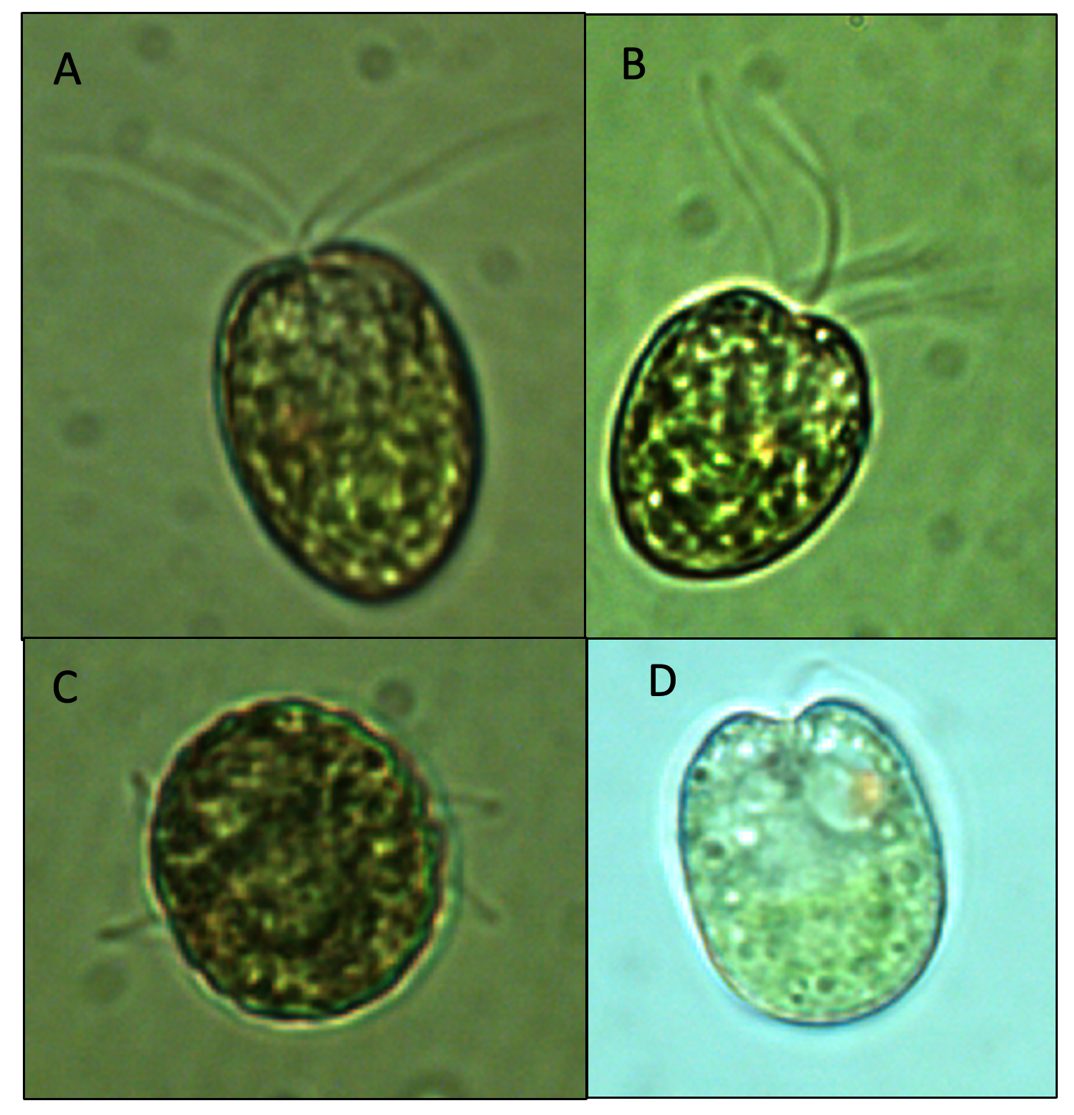
One of the larger flagellated species of Lake Kinneret (after the dinoflagellates), and the only one with four flagella (Plate 1). It is heart-shaped (=cordiform, as its name) or cherry-shaped, ellipsoidal or almost spherical, never twisted, with four equal-length flagella emerging out of a pit or depression in the upper side of the cell (Plate 1). It has a red or , and a single cup-shaped chloroplast usually with a basal . Two contractile vacuoles are present near the base of the flagella.
Ecology
Tetraselmis cordiformis usually occurs in the Kinneret plankton in small numbers of < 50 cells/mL (Fig. 1) and biomass not more than 4 g m-2 (not shown). It is more abundant between February and April and again from August till November but absent in July and rare in December and January (Fig. 2). A technician-effect is noted in our data: a technician was replaced on 1 Jan 2013. It is evident in Fig. 1 that the newer technician counted this species more frequently than the previous one.
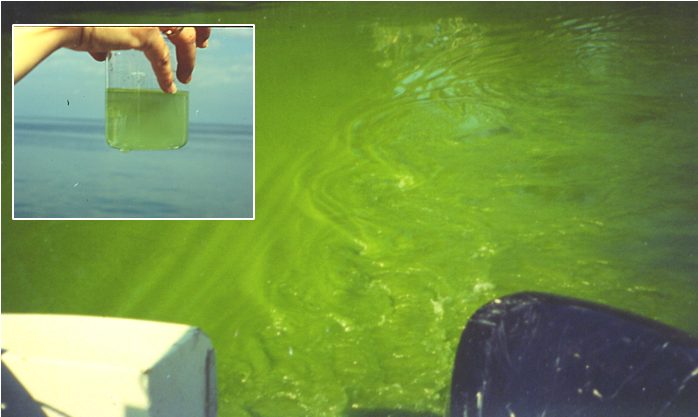
On a single unusual occasion in February 1996 Tetraselmis cordiformis formed an intense bloom that colored the entire lake with a strong grass-green color. This intense bloom disappeared within a few days and was missed by our weekly sampling, but photographic records remain (Plate 2). On another occasion, a massive bloom of this flagellated alga took place in a series of experimental tanks behind the Kinneret Limnological Institute. Again, the bloom was short lived and disappeared within days.
A distinct annual cycle of cell size is evident from our data: cells are smaller size in summer, larger in winter (Figs. 2, 3A). Cell size correlates well with water temperature (R2=0.48, Fig. 3B).
On a single unusual occasion in February 1996 Tetraselmis cordiformis formed an intense bloom that colored the entire lake with a strong grass-green color. This intense bloom disappeared within a few days and was missed by our weekly sampling, but photographic records remain (Plate 2). On another occasion, a massive bloom of this flagellated alga took place in a series of experimental tanks behind the Kinneret Limnological Institute. Again, the bloom was short lived and disappeared within days.
A distinct annual cycle of cell size is evident from our data: cells are smaller size in summer, larger in winter (Figs. 2, 3A). Cell size correlates well with water temperature (R2=0.48, Fig. 3B).
Environmental conditions
T. cordiformis occurred at the full range of water temperatures occurring in the lake, at > 1000 μS cm-1 and Chloride > 210 mg L-1, when Secchi transparency was 2-4 m, euphotic zone depth > 5 m, mostly at pH between 8–9, Chlorophyll < 400 mg m-2, at > 100 mg L-1, when NH4 was low but NO3, Norg and were moderate (Fig. 4).
Cite this record as: Dr. Tamar Zohary, Dr. Alla Alster. 17 August 2026. Electronic publication. Israel Oceanographic & Limnological Research. https://kinneret-algae-atlas.org/ Searched on —.