- Phylum
- Cryptista
- Class
- Cryptophyceae
- Order
- Cryptomonadales
- Habitat
- plankton, pelagic/littoral
- Distinctive features
- heavily grazed by zooplankton, contains phycoerythrin (like cyanobacteria) – fluoresces orange when stained with DAPI. Always present in the water column. Distinctively smaller size than Cryptomonas. Probably mixotrophic.
- Organization
- flagellated single cells
- Color
- reddish to dark brown
- Cell shape
- drop-like
- Cell diameter (D)
- 3 – 6 μm, median: 4.5 μm (N=477).
- Cell length (L)
- 6 – 10 μm, median: 7.8 μm (N=390).
- Cell biovolume
- 40 – 150 μm3, median: 82 μm3.
- Biovolume equation
- V=1.841D2.5264 (regression eqn. between D and V based on 390 measurements of both D and L with V computed for a Half sphere + cone; R2=0.93).
Morphological features
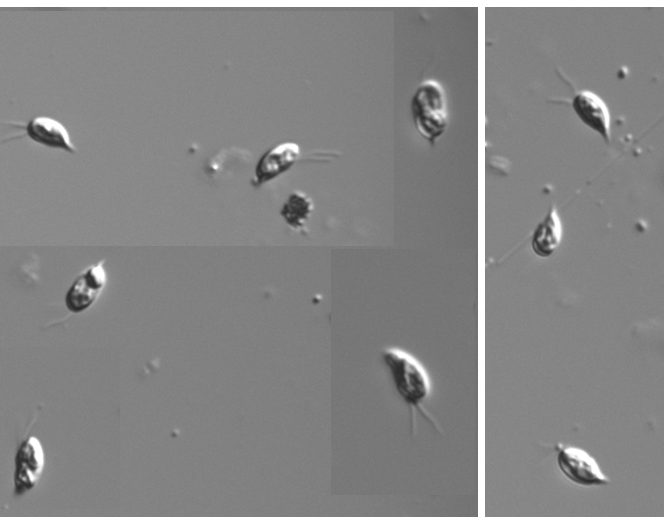
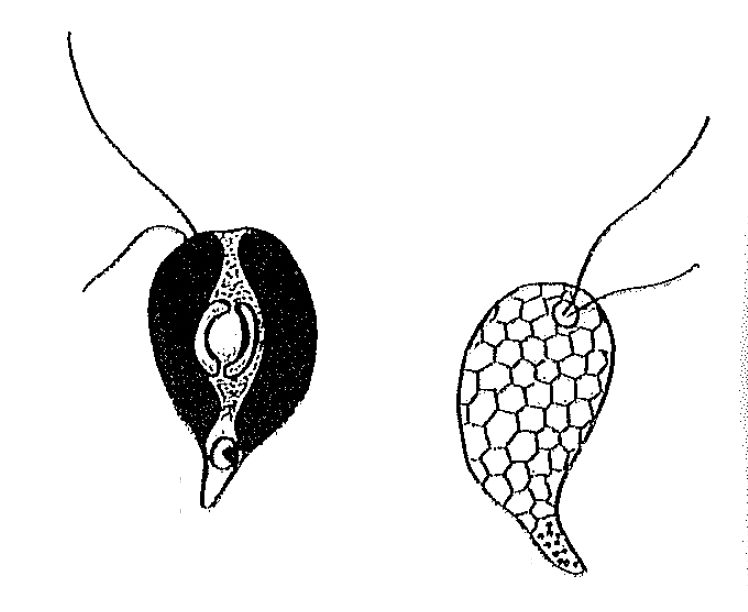
A small drop-shaped monad with two slightly unequal (Plate 1), this is the smaller cryptophyte of Lake Kinneret. A single red (contains phycoerythrin) chloroplast is with margins. A central large surrounded by a thick starch of 2 hemispherical halves. The nucleus is . Its chloroplast fluoresces orange (autofluorescence) when observed under an epifluorescent microscope.
Ecology
Plagioselmis nannoplanctica is present in the Kinneret water column, in the pelagial and littoral, at all times of year, and has been present continuously since 1970 (Fig. 1). It has a distinct annual cycle of peak abundance during winter holomixis (Dec. to Mar.), lowest in summer (Jun. to Oct.; Fig. 2). Indifferent to increasing salinity (or chloride conc.; Fig. 3). Like Cryptomonas, it is present in both the pelagic and littoral zones and is highly grazed by zooplankton.
Environmental conditions
Present at the full range observed in Lake Kinneret of the following environmental variables: Zeu (euphotic zone depth), Secchi depth, pH, NH4, , SO4, Total suspended solids, Turbidity. Abundance increases with increasing and nitrate, and with declining water temperature, , Organic N, total dissolved P (Fig. 3).
Cite this record as: Dr. Tamar Zohary, Dr. Alla Alster. 17 August 2026. Electronic publication. Israel Oceanographic & Limnological Research. https://kinneret-algae-atlas.org/ Searched on —.
Further reading
- B-Beres V 2024. Az egybarazdas moszatok [cryptophyceae] kishatarozoja. Hun-REN OK VOI, Funkcionalis Algologgiai Kutatocsoport.
- Lund JWG 1962. A rarely recorded but very common British alga, Rhodomonas minuta Skuja. British Phycological Bulletin, 2: 133-139.
- Novarino G 2002. Cryptophyta (Cryptomonads). In: The freshwater algal flora of the British Isles. An identification guide to freshwater and terrestrial algae. Eds: John DM, Whitton BA, Brook AJ. pp. 240-249. Cambridge: Cambridge University Press.
- Zohary T, Yacobi YZ, Alster A, Fishbein T, Lippman S, Tibor G. 2014. Phytoplankton. Chap. 10 In: Zohary T, Sukenik A, Berman T, Nishri A. [eds] Lake Kinneret: Ecology and Management, pp. 161-190. Springer, Heidelberg.