- Phylum
- Dinoflagellata
- Class
- Dinophyceae
- Order
- Peridiniales
- Habitat
- plankton, pelagial
- Distinctive features
- mixotroph, heavily grazed by zooplankton, capable of using bicarbonate for photosynthesis.
- Organization
- flagellated single cells
- Color
- yellow to golden-brown
- Cell shape
- near-sphere
- Cell diameter (D)
- 29 – 40.5 μm, median: 34 μm (N=580)
- Cell length (L)
- 32 – 44 μm, median: 39 μm (N=262)
- Cell biovolume
- 14,000 – 40,500 μm3, median: 21,300 μm3. Larger cell size in winter, smaller in summer (see Fig. 2b).
- Biovolume equation
- V = 0.9405 D2.8596 (regression eqn. based on >500 measurements of both D and L with V computed for a prolate spheroid).
Morphological features
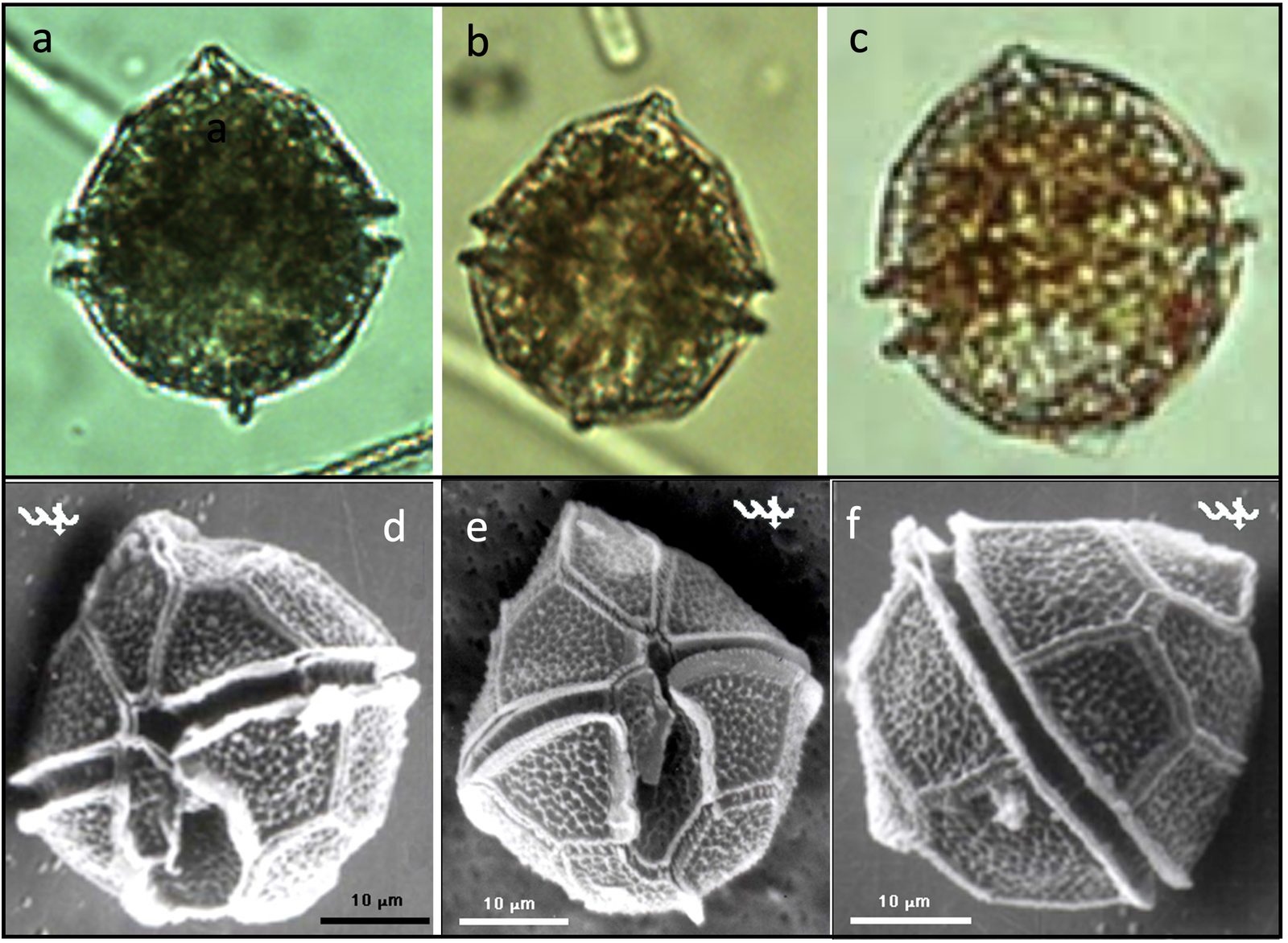
Peridiniopsis borgei is the largest of several species of Peridiniopsis, Durinskia, Glechodinium, Naiadinium, and Parvodinium occurring in the lake. Its shape is almost a sphere (Plate 1), with the , or , markedly transversing it in the middle. The is conical with a mouth-like tip at the (highest point), the is broadly rounded. Sometimes the hypotheca has an extension at its bottom end, like a small “foot”. Chloroplasts are numerous and ribbon shaped.
Diagnostic features seen with electron microscopy: the slightly extends into the epitheca, it widens in the hypotheca, it does not reach the (Plate 1 d,e). Sulcal margins sometimes have raised edges.
Diagnostic features seen with electron microscopy: the slightly extends into the epitheca, it widens in the hypotheca, it does not reach the (Plate 1 d,e). Sulcal margins sometimes have raised edges.
Ecology
Peridiniopsis borgei is one of several subdominant dinoflagellates, common in spring each year (Fig. 1). It reaches peak abundance of several tens of cells per ml in May-June and remains present in the plankton until October (Fig. 2a). The contribution of Peridiniopsis borgei to total biomass was usually < 10% but on rare occasions it reached 40%. Peridiniopsis borgei shows an annual cycle also of cell size (Fig. 2b). Its cellular volume increases during the bloom increase phase, reaching maximum size (diameter: 37 μm, volume: 31,000 μm3) before reaching peak cell abundance, then cell size declines to a minimum (diameter: 27 μm, volume: 11,000 μm3) at about the same time as the minimum cell abundance. Peridiniopsis borgei is potentially capable of using HCO3 as C source for photosynthesis when pH is high and CO2 availability low (Berman-Frank et al. 1994). It is an important food source for zooplankton in late spring, after the decline of Peridinium gatunense (Zohary et al. 1994).
Environmental conditions
Peridiniopsis borgei biomass > 5 g m-2 occurred more frequently but not exclusively at pH > 8.5, < 130 mg L-1, chloride <280 mg L-1, at water temperatures >17°C (Fig. 3), and over the full range of TDP and calcium concentrations, when the lake was stratified (not shown).
Cite this record as: Dr. Tamar Zohary, Dr. Alla Alster. 7 August 2026. Electronic publication. Israel Oceanographic & Limnological Research. https://kinneret-algae-atlas.org/ Searched on —.
Further reading
- Berman-Frank I, Zohary T, Erez J, Dubinsky Z. 1994. CO₂ availability, carbonic anhydrase, and the annual dinoflagellate bloom in Lake Kinneret. Limnol. Oceanogr. 39:1822-1834.
- Pollingher U, Hickel B. 1991. Dinoflagellate associations in a subtropical lake (Lake Kinneret, Israel). Arch. Hydrobiol. 120:267-285.
- Zohary T, Erez J, Gophen M, Berman-Frank I, Stiller M. 1994. Seasonality of stable carbon isotopes within the pelagic food web of Lake Kinneret. Limnol. Oceanogr. 39:1030-1043.