- Phylum
- Chlorophyta
- Class
- Chlorophyceae
- Order
- Volvocales
- Habitat
- plankton - littoral
- Distinctive features
- flagellated colonies of densely-packed cells, often with
- Organization
- flagellated coenobia
- Color
- green
- Cell shape
- spherical
- Colony shape
- subspherical
- Cell diameter (D)
- 8 – 17 μm
- Cell biovolume
- 40 – 400 μm3
- Biovolume equation
- Sphere V, μm3 = 4/3 π (D/2)3.
- Colony diameter
- 20-60 μm
- Cells per colony
- 8-16
Morphological features
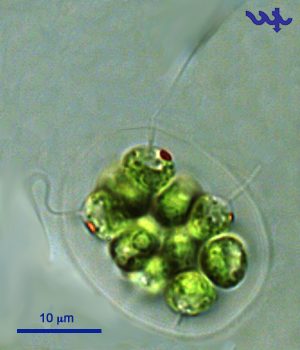
The coenobia are made of 8 or 16 cells compressed into a dense spherical aggregate that is surrounded by an envelope of mucilage. Each cell has two equal-length that are longer than the cell. With a cup-shaped chloroplast, 1 or more , 2 contractile vacuoles an red eyespot.
Ecology
Pandorina morum is common in the littoral zone of Lake Kinneret, but practically never seen in the pelagic water. Hence there are no ecological data for it. The species is common in stratified shallow lakes rich in nitrate. The specimen in Plate 1 was collected at the shore by the Kinneret Limnological Institute in March 2006.
Cite this record as: Dr. Tamar Zohary, Dr. Alla Alster. 17 August 2026. Electronic publication. Israel Oceanographic & Limnological Research. https://kinneret-algae-atlas.org/ Searched on —.