- Phylum
- Charophyta
- Class
- Zygnematophyceae
- Order
- Zygnematales
- Habitat
- plankton
- Distinctive features
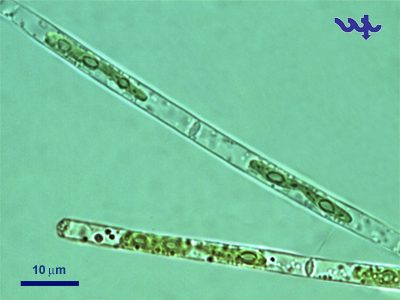
- relatively large green filaments (compared with other filamentous species from Lake Kinneret). Unbranching. Ribbon-shaped chloroplast that does not fill entire cell, with circular lined-up along it.
- Organization
- filamentous
- Color
- green
- Cell shape
- cylinder
- Colony shape
- long filaments made of long cylindrical cells
- Cell diameter (D)
- 3.1 – 4.7 μm, median: 3.7 μm (N=1200)
- Cell length (L)
- 36 – 95 μm, median: 60 μm (N=1200): cells are >10 times longer than wide
- Cell biovolume
- 350 – 1300 μm3, median: 650 μm3
- Biovolume equation
- cylinder V, μm3 = π (D/2)2 L
- Filament length
- 130 - 800 μm
- Cells per filament
- Usually 1-6 but can be as long as 40 cells
Morphological features
A filamentous green alga made of a string of cylinder-shaped cells. Evident symmetry about the longitudinal axis. The single chloroplast fills a third to three-quarters of the cell length, leaving the far ends of the cell colorless (Plate 1). The cross wall connecting two cells is transparent, looks like a clear ring (Plate 1). The chloroplast is ribbon shaped and is (lies along the long axis of the cell). As typical for the genus, this ribbon-shaped chloroplast can twist to orient itself to optimal light conditions (Plate 1). Thus, the chloroplast may be in face view, edge view, or twisted. A series of 4-6 pyrenoids (round green organelles) are lined-up along the chloroplast. The nucleus lies at the center of the cell, beside the chloroplast and against the cell wall.
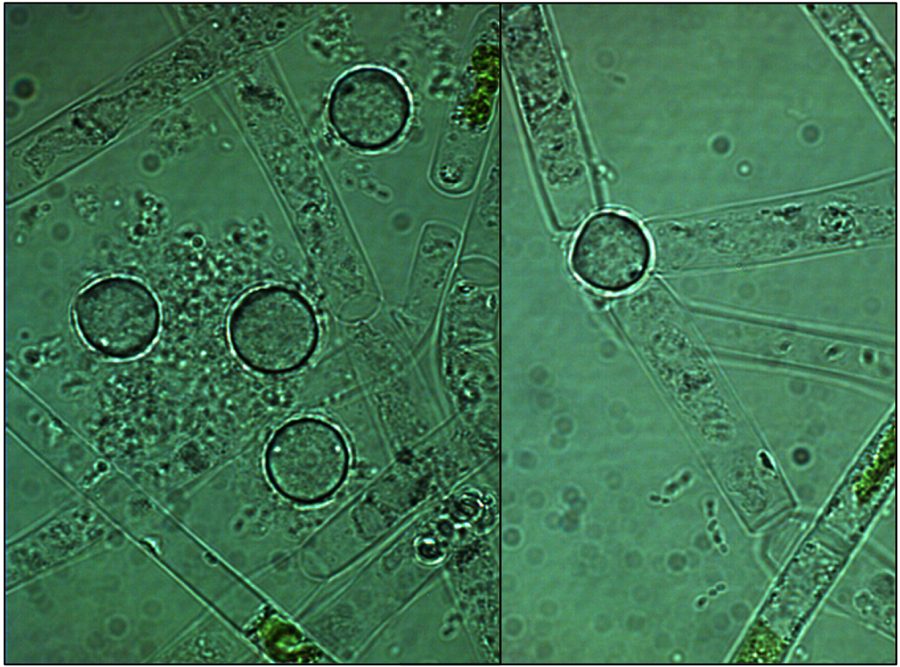
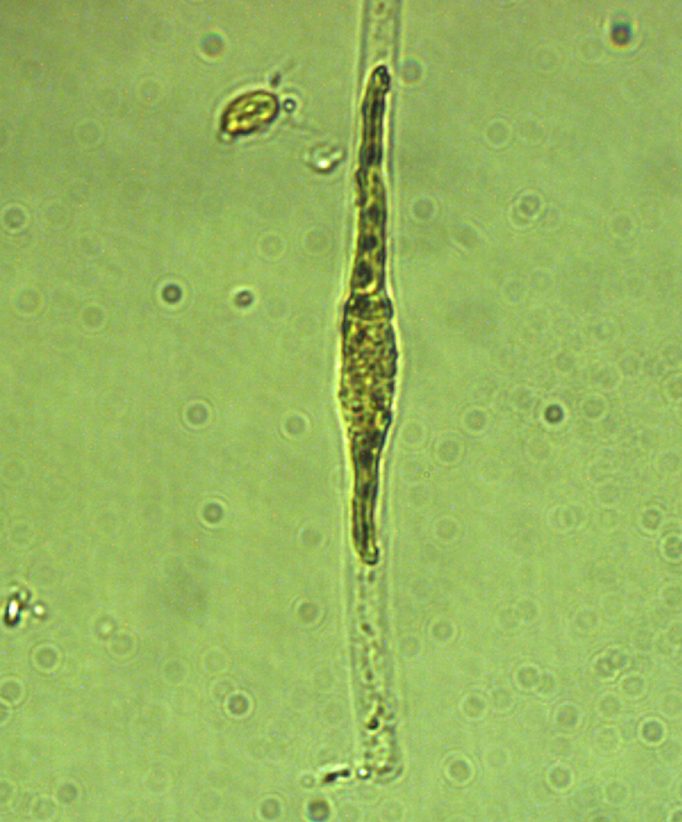
The vegetative cell structure of Mougeotia is identical with that of Debarya, the two genera can be distinguished and their species determined microscopically only based on sexual structures, and . and zygospores were observed only twice, in 2008 and 2009, on Kinneret shore samples. Prior to that, this filamentous alga was mis-identified as Debarya sp. But based on the zygospores (Plate 2), John Hall from the New York Botanical Gardens identified the genus as Mougeotia, suggesting the species may be M. gracillima. To this day we are uncertain about the species identification and refer to our organism as Mougeotia sp. Formation of (asexual resting spores) (Plate 3) was observed mostly in littoral populations.
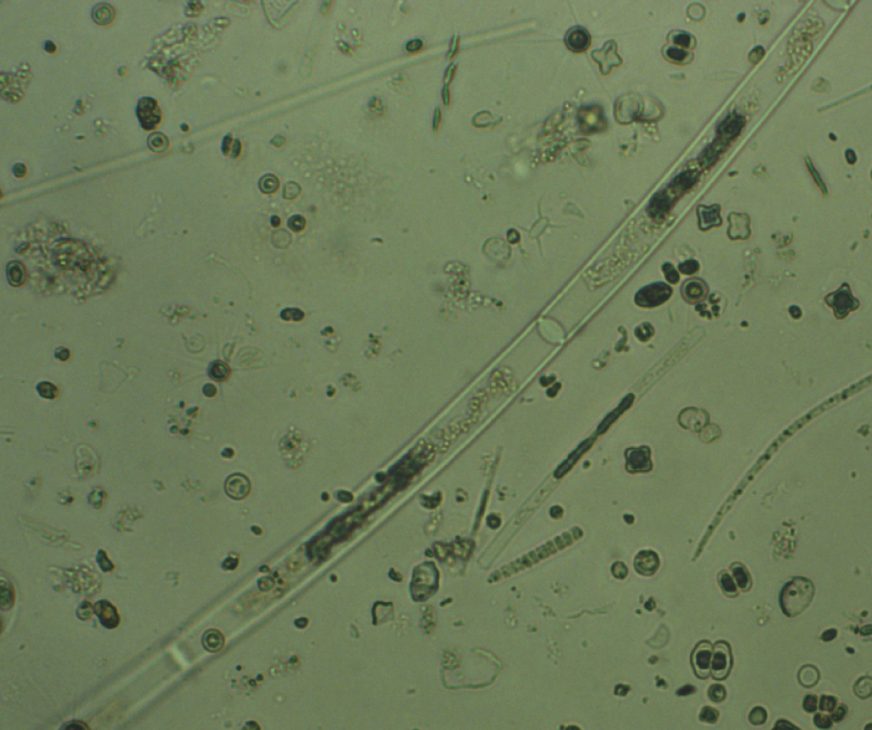
In 2017, giant species or variety of Mougeotia appeared in Lake Kinneret, with cell diameter 3-4 times greater and cell length double that of the common Kinneret Mougeotia (Plate 4). But this giant didn’t persist.
The vegetative cell structure of Mougeotia is identical with that of Debarya, the two genera can be distinguished and their species determined microscopically only based on sexual structures, and . and zygospores were observed only twice, in 2008 and 2009, on Kinneret shore samples. Prior to that, this filamentous alga was mis-identified as Debarya sp. But based on the zygospores (Plate 2), John Hall from the New York Botanical Gardens identified the genus as Mougeotia, suggesting the species may be M. gracillima. To this day we are uncertain about the species identification and refer to our organism as Mougeotia sp. Formation of (asexual resting spores) (Plate 3) was observed mostly in littoral populations.
In 2017, giant species or variety of Mougeotia appeared in Lake Kinneret, with cell diameter 3-4 times greater and cell length double that of the common Kinneret Mougeotia (Plate 4). But this giant didn’t persist.
Ecology
Mougeotia is relatively new to Lake Kinneret, in the 1960s, 1970s and 1980 it was never seen. It first appeared in the plankton in May 1998 (Zohary et al. 2019). It was rare until 2004, but since then it is a common component of the Kinneret plankton. It formed intense blooms in 2005, 2006, 2009, 2010, 2012 and 2014, since then its concentrations remained low, with moderate seasonal peaks (Fig. 1A), with maximum cell abundances usually between April and August (Fig. 2), but not always. Initially Mougeotia bloomed only in spring, but in 2009 it was abundant all autumn, and in 2010 it formed a major autumnal bloom extending into early winter 2011 (Fig. 1). The depth-distribution of Mougeotia is usually uniform.
We recorded a general trend of increasing Mougeotia cell size over time (Fig. 1B). Filament length is variable and depends on the number of cells per filament. This number didn’t change much over time (Fig. 1C) but shows strong seasonality, with more cells per filament from January to June than during the second half of the year (Fig. 2). Concurrently, cell size is also larger during the first half of the year (Fig. 2).
We recorded a general trend of increasing Mougeotia cell size over time (Fig. 1B). Filament length is variable and depends on the number of cells per filament. This number didn’t change much over time (Fig. 1C) but shows strong seasonality, with more cells per filament from January to June than during the second half of the year (Fig. 2). Concurrently, cell size is also larger during the first half of the year (Fig. 2).
Physiological features
A Kinneret strain of Mougeotia was isolated by Ora Hadas in 2007 and is kept at the KLL culture collection, Strain #INCCA-Ch1001. Several additional Kinneret Mougeotia strains were isolated in later years by Alla Alster. In laboratory growth experiments conducted by Yishai Gabai (MSc student) highest growth rate was attained at low light (3 μE m-2 s-1) and with stirring, optimal growth temperature was 29°C.
Monitoring data (cell abundance, chlorophyll concentrations, primary production) from the intense bloom in April-May 2005, when Mougeotia biomass contributed > 60% of total phytoplankton biomass, were used by Yacobi and Zohary (2010) to derive the physiological parameters given in Table 1. Notably, Mougeotia exhibited particularly low assimilation numbers and long turnover times. This species grows relatively slowly.
Table 1. Physiological parameters for Kinneret Mougeotia sp. based on field measurements
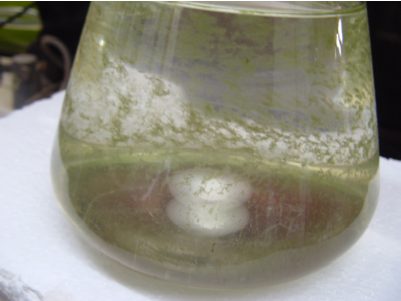
Additional features: Mougeotia filaments are known to attach to solid substrates by means of rhizoid-like outgrowths from the basal cells. The Kinneret strain of Mougeotia grown with stirring adhered to the walls of the flask (Plate 5). It was always one end of a filament that became glued to the glass. Adhering increased with increasing flow speed from 5 to 25 cm/sec (unpublished laboratory experiments conducted by Yishai Gabai). The chloroplast of Mougeotia rotates about its long axis of the cell to change the amount of surface area exposed to light. In low light, the large flat side of the chloroplast facs the light. In bright light, the narrow edge profile is turned towards the light.
Monitoring data (cell abundance, chlorophyll concentrations, primary production) from the intense bloom in April-May 2005, when Mougeotia biomass contributed > 60% of total phytoplankton biomass, were used by Yacobi and Zohary (2010) to derive the physiological parameters given in Table 1. Notably, Mougeotia exhibited particularly low assimilation numbers and long turnover times. This species grows relatively slowly.
Table 1. Physiological parameters for Kinneret Mougeotia sp. based on field measurements
| Physiological parameter | Average ± SD | N |
|---|---|---|
| C:Chl ratio | 45± 6 | 37 |
| Assimilation number (at depth of max photosynthesis) , mgC mg Chl⁻¹h⁻¹ | 0.75 ±0.25 | 4 |
| Turnover time, d | 5.5±0.8 | 4 |
Environmental conditions
No significant relationship was found between Mougeotia biomass and any of the environmental factors monitored in Lake Kinneret: Mougeotia cell abundance and biomass were indifferent to water temperature, shortwave radiation thermocline depth, chloride concentrations, pH, DIN, , TP (Zohary et al. 2019) as well as any other variable tested. This makes it a particularly flexible generalist taxon, with exceptionally high physiological plasticity, an alga that thrives and even dominates under a wide range of environmental conditions, making it a successful invasive species. This vast physiological plasticity probably made it possible for Mougeotia to establish its population in Lake Kinneret, develop intense blooms and become one of the dominant biomass-contributing species. Still, this hypothesis on the plasticity needs to be tested experimentally.
Another possible explanation to Mougeotia’s ability to maintain its populations under the full range of environmental parameters encountered in the lake is that there could be two or more cryptic species (that look alike under the microscope but are distinct genetically) occurring in succession or with overlap. The hypothesis on a Mougeotia cryptic species complex requires confirmation using molecular tools. The hypothesis of vast phenotypic plasticity within a species is not in conflict with the cryptic species hypothesis, rather, the observed Mougeotia patterns might be related to a combination of both.
We anticipate that with global changes, this opportunistic filamentous alga is likely to invade lakes worldwide where it may become a major biomass-contributing species.
Another possible explanation to Mougeotia’s ability to maintain its populations under the full range of environmental parameters encountered in the lake is that there could be two or more cryptic species (that look alike under the microscope but are distinct genetically) occurring in succession or with overlap. The hypothesis on a Mougeotia cryptic species complex requires confirmation using molecular tools. The hypothesis of vast phenotypic plasticity within a species is not in conflict with the cryptic species hypothesis, rather, the observed Mougeotia patterns might be related to a combination of both.
We anticipate that with global changes, this opportunistic filamentous alga is likely to invade lakes worldwide where it may become a major biomass-contributing species.
Cite this record as: Dr. Tamar Zohary, Dr. Alla Alster. 17 August 2026. Electronic publication. Israel Oceanographic & Limnological Research. https://kinneret-algae-atlas.org/ Searched on —.
Further reading
- Kaplan-Levy RN, Alster-Gloukhovski A, Benyamini Y, Zohary T. 2016. Lake Kinneret phytoplankton: integrating classical and molecular taxonomy. Hydrobiologia 764(1):283-302.
- Tapolczai K, Anneville O, Padisak J, Salmaso N, Morabito G, Zohary T, Tadonléké RD, Rime F. 2015. Occurrence and mass development dynamics of Mougeotia spp. (Zygnemataceae) in large, deep lakes. Hydrobiologia 745: 17-29. doi:10.1007/s10750-014-2086-z.
- Yacobi YZ, Zohary T. 2010. Carbon: chlorophyll a ratio, assimilation numbers and turnover times in Lake Kinneret phytoplankton. Hydrobiologia 639: 185-196, DOI:10.1007/s10750-009- 0023-3.
- Zohary T, Alster A, Hadas O, Obertegger U. 2019. There to stay: opportunistic and versatile filamentous green alga Mougeotia in Lake Kinneret, Israel. Hydrobiologia 831: 87-100.
- Zohary T, Yacobi YZ, Alster A, Fishbein T, Lippman S, Tibor G. 2014. Phytoplankton. Chap. 10 In: Zohary T, Sukenik A, Berman T, Nishri A. [eds] Lake Kinneret: Ecology and Management, pp. 161-190. Springer, Heidelberg.