- Phylum
- Chlorophyta
- Class
- Chlorophyceae
- Order
- Volvocales
- Habitat
- plankton
- Distinctive features
- flagellated colonies, cells more or less evenly distributed within a common spherical envelope
- Organization
- flagellated coenobia
- Color
- green
- Cell shape
- spherical
- Colony shape
- spherical to ellipsoidal
- Cell diameter (D)
- 4 – 10 μm, median: 6 μm (N=54).
- Cell biovolume
- 25 – 460 μm3, median: 100 μm3.
- Biovolume equation
- Sphere V, μm3 = 4/3 π (D/2)3
- Colony diameter
- 40-150 μm
- Cells per colony
- 4-16
Morphological features
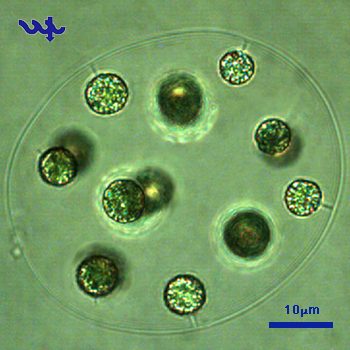
Eudorina elegans coenobia in Lake Kinneret are spherical or ellipsoidal, 60-200 μm in diameter, with 4 to 16 cells per colony. Individual cells are spherical or slightly pear-shaped, regularly arranged at periphery of a mucilaginous envelope. With cup-shaped chloroplast and up to 5 per cell, , two contractile apical vacuoles. The two equal-length are longer than the cell. They protrude through the mucilaginous envelope and enable movement of the colony as a single unit.
Ecology
Eudorina elegans is rare in our Kinneret samples, in 50 years of monitoring the species was counted <20 times, most of them since 2013 (Fig. 1).
Environmental conditions
The few times when Eudorina elegans was counted occurred at the full range of temperature, NO3 and NH4, when chlorophyll was < 500 mg m-2, chloride > 230 mg L-1, Zeu ranged 6-11 m, Secchi depth ranged 2-4 m, was > 100 mg CaCO3 L-1, Ca > 44 mg L-1, < 0.5 mg L-1 and TDP < 100 μg L-1
Cite this record as: Dr. Tamar Zohary, Dr. Alla Alster. 17 August 2026. Electronic publication. Israel Oceanographic & Limnological Research. https://kinneret-algae-atlas.org/ Searched on —.