- Phylum
- Dinoflagellata
- Class
- Dinophyceae
- Order
- Peridiniales
- Habitat
- plankton, littoral (more abundant) and pelagial,
- Distinctive features
- the only non-pigmented dinoflagellate of Lake Kinneret.
- Organization
- flagellated single cells
- Color
- pinkish, non-pigmented (heterotrophic)
- Cell shape
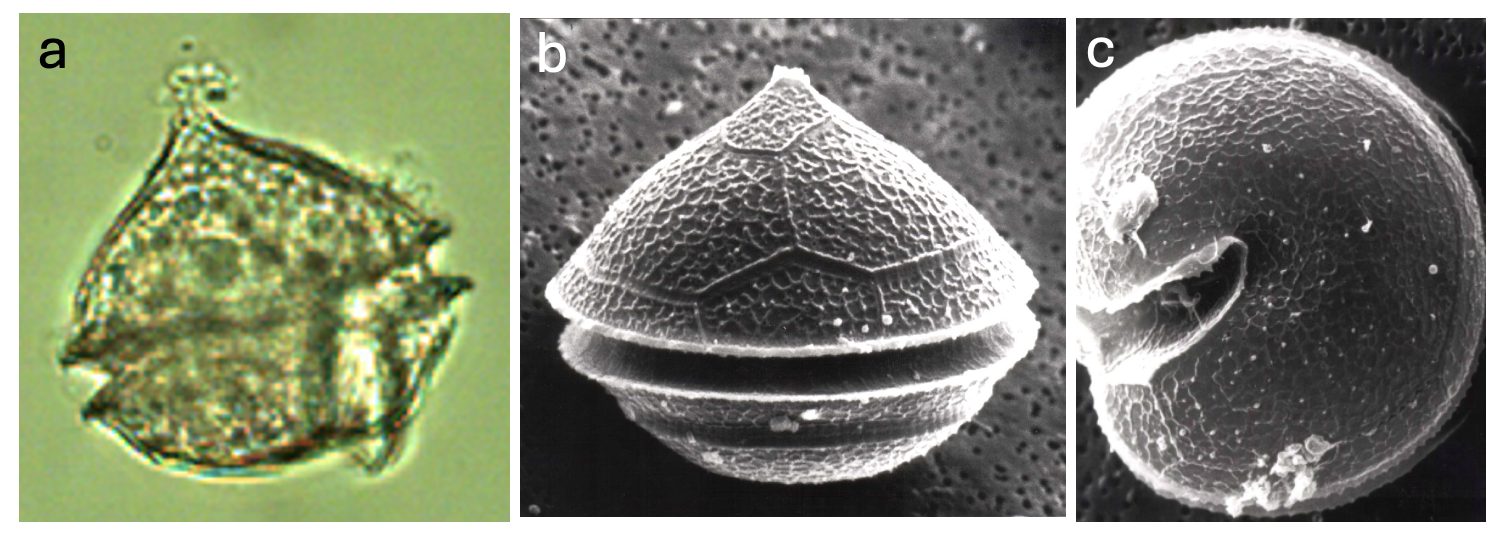
- flat cone (Chinese hat) on top of a half-sphere (Plate 1).
- Cell diameter (D)
- 34 - 47 μm, median: 38 μm (N=92)
- Cell length (L)
- 17 – 23 μm, median: 19 μm (N=92)
- Cell biovolume
- 15,000 – 40,000 μm3, median: 22,000 μm3.
- Biovolume equation
- V, μm3 = (π/12) *D2 *(D+h) (= volume of half sphere+cone, see Hillebrand et al. 1999).
Morphological features
Diplopsalis acuta is the only known heterotrophic (non-pigmented) thecate dinoflagellate in the lake’s pelagic waters. Its shape is distinct, of a half sphere with a Chinese hat on top of it (Plate 1). Another feature differentiating it from other Kinneret dinoflagellates is that its diameter at the is greater than its height. Its are thick and distinct. Chloroplasts and are lacking (heterotrophic). The is pink. The is broadly rounded and slightly flattened dorsiventrally. Plates are not sculptured and have no reticulations.
Ecology
Diplopsalis acuta is one of the regularly occurring dinoflagellates of Lake Kinneret, although it is present in low concentrations, usually < 2 cells mL-1 (Fig. 1). It appears in the plankton from November (onset of destratification) to July, with peak abundance in March (Fig. 2), before the lake stratifies, and earlier than most other Kinneret dinoflagellates. It is more common in littoral samples.
Being heterotrophic, Diplopsalis acuta is excluded from the computation of total phytoplankton biomass in our routine monitoring.
Being heterotrophic, Diplopsalis acuta is excluded from the computation of total phytoplankton biomass in our routine monitoring.
Environmental conditions
Higher cell abundances of this species occurred at higher Kinneret (> 100 mg CaCO3 L-1), Ca (> 40 mg L-1), TDP, and concentrations, when Dissolved organic N () ranged 0.1-0.5 mg L-1 and Secchi depth ranged 2-4 m, At low turbidity (< 4 NTU) waters, and low Si (Fig. 3). Abundance seemed to be indifferent to water level, , chloride, short wave radiation. Abundance was higher with lower long-wave radiation levels and water temperatures < 25°C, but both may be correlates of the time of year of its peak abundance.
Cite this record as: Dr. Tamar Zohary, Dr. Alla Alster. 7 August 2026. Electronic publication. Israel Oceanographic & Limnological Research. https://kinneret-algae-atlas.org/ Searched on —.