- Phylum
- Cryptista
- Class
- Cryptophyceae
- Order
- Cryptomonadales
- Habitat
- plankton pelagic/littoral
- Distinctive features
- heavily grazed by zooplankton, contains phycoerythrin (like cyanobacteria), its chloroplast fluoresces orange when observed under epifluorescent microscope. Always present in the water column of Lake Kinneret, with peak biomass in winter and another peak in summer. Distinctively larger size than Plagioselmis. Probably mixotrophic.
- Organization
- flagellated single cells
- Color
- dark brown
- Cell shape
- oval
- Cell diameter (D)
- 6 – 17 μm, median: 9.2 μm (N=2400).
- Cell length (L)
- 10 – 30 μm, median: 14 μm (N=424).
- Cell biovolume
- 400 – 2000 μm3, median: 700 μm3. Larger cell size in winter, smaller in summer (see Figs. 2, 4).
- Biovolume equation
- V=0.7076D3.0772 (regression eqn. based on 424 measurements of both D and L with V computed for a prolate spheroid).
Morphological features
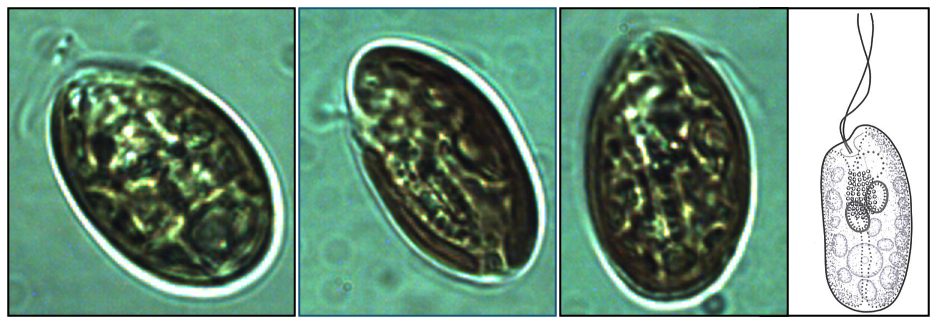
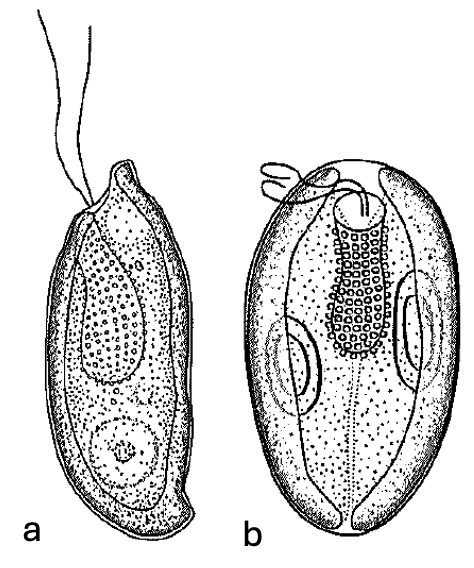
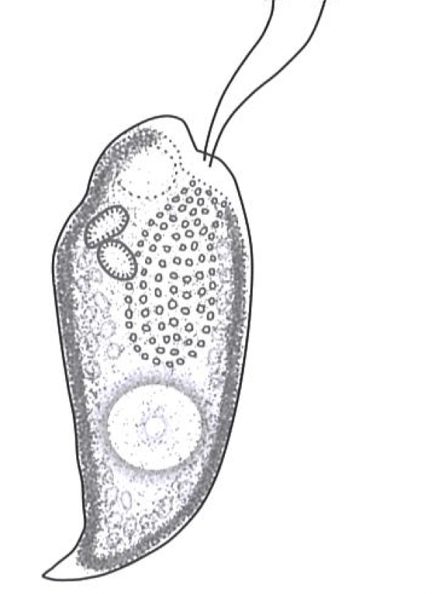
Relatively large free-swimming cells, dark brown in color, shaped as an elongated monad with two equal or subequal length extending out of a (longitudinal groove on the cell surface) in the upper part of the cell. The bottom end is rounded. With 1 or 2 chloroplasts per cell located at the cell periphery, phycoerythrin as the principal accessory pigment (giving the deep brown color), and a single large and central . Cryptomonas is differentiated from Plagioselmis in being the larger cryptophyte found in Lake Kinneret. Three species of Cryptomonas occur in the lake, including C. ovata, C. marssonii and C. curvata (Plates 1-3). Dues to the similar size and limited diagnostic characters, for the routine monitoring the 3 species have all been counted under a single code for the genus Cryptomonas, and the data presented in figures 1-4 are for the genus.
Ecology
Cryptopmonas spp. are always present in the water column (Fig. 1), with higher abundances in winter (Dec to Feb) but also in summer (Jul - Sep) and lowest in April-May, at the time of the Peridinium bloom (Fig. 2). It is possible that the two seasonal abundance peaks are due to two different Cryptopmonas species. Abundance is usually < 250 cells/mL (Fig. 2). A noteworthy exception occurred during the cold winter of 1992, when the Peridinium bloom developed later than usual and Cryptomonas abundance in February exceeded 1000/mL (Fig. 1). Overall, when Peridinium gatunense is abundant in the water, Cryptomonas spp. abundance is low, and visa-versa (Fig. 3). Cell size of Cryptomonas varies seasonally, with larger cell volume in winter (Fig. 4a).
Environmental conditions
Kinneret Cryptomonas is resistant to higher chloride concentrations and is present at all ambient water temperatures (Fig. 5). High abundances of Cryptomonas spp. are associated with mixing depth (Zmix) > 35 m typical of the wintertime when the water column is fully mixed; euphotic zone depth range of 5-12 m (not shown); higher ; lower organic N (Fig. 5).
Cell size tends to decline with water temperature and increase with Alkalinity and Ca concentration (Fig. 4 b, c, d).
Cell size tends to decline with water temperature and increase with Alkalinity and Ca concentration (Fig. 4 b, c, d).
Cite this record as: Dr. Tamar Zohary, Dr. Alla Alster. 17 August 2026. Electronic publication. Israel Oceanographic & Limnological Research. https://kinneret-algae-atlas.org/ Searched on —.
Further reading
- B-Beres V. 2024. Az egybarazdas moszatok [cryptophyceae] kishatarozoja. Hun-REN OK VOI, Funkcionalis Algologgiai Kutatocsoport.
- Javornicky P 2003. Cryptomonas ovata Ehrenberg (Cryptophyceae) and some related species. Algological Studies/Archiv für Hydrobiologie, Supplement 110: 43-65.
- Novarino G 2011. Cryptophyta (Cryptomonads). In: The freshwater algal flora of the British Isles. An identification guide to freshwater and terrestrial algae. Second edition. (John, D.M., Whitton, B.A. & Brook, A.J. Eds), pp. 240-249. Cambridge: Cambridge University Press.
- Zohary T, Yacobi YZ, Alster A, Fishbein T, Lippman S, Tibor G. 2014. Phytoplankton. Chap. 10 In: Zohary T, Sukenik A, Berman T, Nishri A. [eds] Lake Kinneret: Ecology and Management, pp. 161-190. Springer, Heidelberg.