- Phylum
- Euglenophyta
- Class
- Euglenophyceae
- Order
- Euglenales
- Habitat
- epibiont on zooplankton
- Distinctive features
- attached to zooplankton, mostly copepods and rotifers.
- Organization
- colonies
- Color
- grass green
- Cell shape
- oval
Morphological features
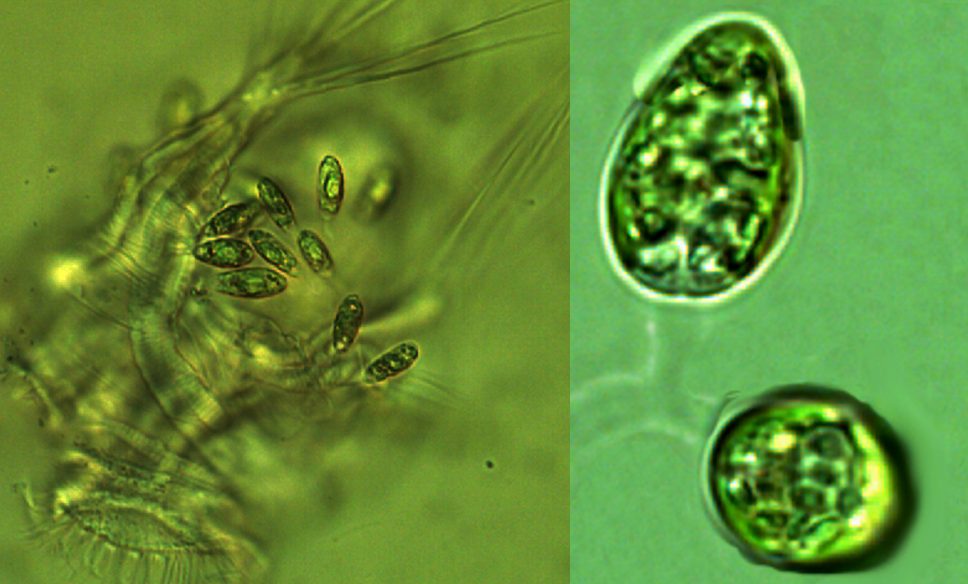
Colacium species are sessile although free-swimming after cell division. The sessile cells are attached to their biotic substrate (zooplankton in Lake Kinneret) with a branching mucilaginous stalk. Several cells are attached each to one of the branches of the stalk to form loosely bounds colonies of several cells. Motile cells look like Euglena: they are naked, with a single emergent , an and numerous disk-like chloroplasts. On settling the cells shed their flagellum, rarely divide, and secrete a mucilaginous .
Ecology
Colacium colonies are occasionally seen as epibionts on zooplankton, especially on copepods and rotifers (Plate 1). Since they are sessile, they are not observed in our phytoplankton samples, were never counted and we have no corresponding environmental data.
Cite this record as: Dr. Tamar Zohary, Dr. Alla Alster. 7 August 2026. Electronic publication. Israel Oceanographic & Limnological Research. https://kinneret-algae-atlas.org/ Searched on —.