- Phylum
- Haptophyta
- Class
- Coccolithophyceae
- Order
- Prymnesiales
- Habitat
- plankton, pelagic/littoral
- Distinctive features
- A tiny flagellated species that is seasonally extremely abundant (thousands of cells/mL), probably mixotroph, heavily grazed by zooplankton.
- Organization
- flagellated single cells
- Color
- yellow to golden-brown
- Cell shape
- spheroid
- Cell diameter (D)
- 2.9 – 5.2 μm, median: 3.9 μm (N=100).
- Cell biovolume
- 13 – 76 μm3, median: 34 μm3.
- Biovolume equation
- sphere V = 4/3 π *(D/2)3.
Morphological features
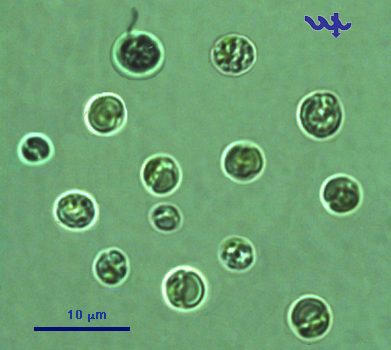
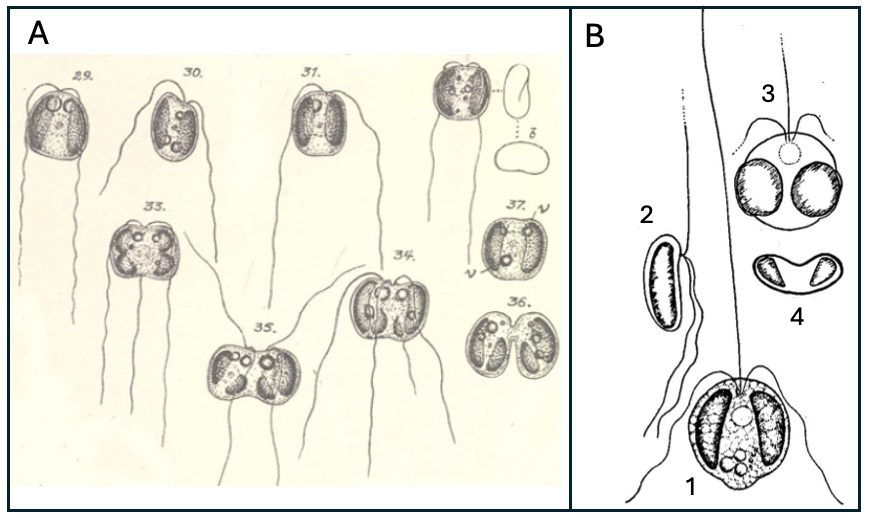
This species comprises the smallest (3 - 5 μm diameter), but very common flagellates of Lake Kinneret (Plate 1). Cells have a , spheroid shape except when dividing (Plate 2A), with 2 of equal or near-equal length, 1 (Plate 2B), 2 chloroplasts, 2 contractile vacuoles, and a (Plates 1, 2). The flagella are much longer than the cell. During swimming, one flagellum is directed forward, whereas the other trails behind. The haptonema that may be mistaken for a third flagellum, is a thread-like organelle used for attachment and catching prey. It is thinner and more delicate than the flagella and rarely seen under a light microscope, because it often contracts and hides against the cell wall. During cell division there is a stage when the two daughter cells are still contained within the same cell wall thus the cell seems particularly wide and with 4 flagella (Plate 2A).
Skuja, who first described Erkenia subaequiciliata in 1948, didn’t see its haptonema and placed it with the Chrysophyta, although in all other attributes it resembled the haptophyte Chrysochromulina parva Lackey 1939. With more advanced microscopy it was shown in the 1960s that the two species are identical, and the earlier name, Chrysochromulina parva, took over.
Skuja, who first described Erkenia subaequiciliata in 1948, didn’t see its haptonema and placed it with the Chrysophyta, although in all other attributes it resembled the haptophyte Chrysochromulina parva Lackey 1939. With more advanced microscopy it was shown in the 1960s that the two species are identical, and the earlier name, Chrysochromulina parva, took over.
Ecology
Chrysochromulina parva is the smallest flagellated species occurring in Lake Kinneret. At times it is incredibly abundant, reaching concentrations of > 1000 cells mL-1; an all-time maximum of 11,900 cells mL-1 was recorded in April 2019 (Fig. 1). Despite their high abundance, their minute size makes their contribution to total phytoplankton biomass usually negligible, on average only 0.4%. The max biomass contribution ever recorded was 7.9 g m-2 and 13% of the total biomass. Chrysochromulina parva is abundant in winter – spring, it is rare or completely absent from the water column in the summer and re-appears in the fall (Fig. 2).
Environmental conditions
occurs at the full range of temperatures, water levels, , chloride, , Ca and nitrate concentrations recorded in Lake Kinneret. Higher abundances were restricted to a relatively narrow range of long wave radiation, between 325-375 Watt m-2, to overall low chlorophyll concentration (i.e. not during major blooms of other species), at < 0.4 mg L-1, NH4 < 0.1 mg L-1, organic N around 0.5 mg L-1, pH in the range of 8-9 and Secchi depth between 1-4 m (Fig. 3).
Cite this record as: Dr. Tamar Zohary, Dr. Alla Alster. 17 August 2026. Electronic publication. Israel Oceanographic & Limnological Research. https://kinneret-algae-atlas.org/ Searched on —.