- Phylum
- Rhodophyta
- Class
- Bangiophyceae
- Order
- Bangiales
- Habitat
- benthos, periphyton
- Distinctive features
- filaments form dark fur-like fleecy mats at air-water interface in shallow waters (few cm) close to the waterline. The species is found in both marine and fresh waters.
- Organization
- filamentous (initially uniseriate, later multiseriate)
- Color
- dark red-brown
- Cell shape
- cylinder
- Cell diameter (D)
- ~ 20 μm (but highly variable)
- Filament length
- Several centimeters
Morphological features
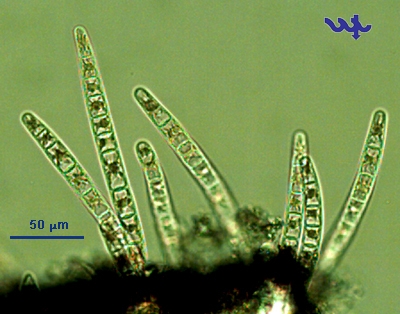
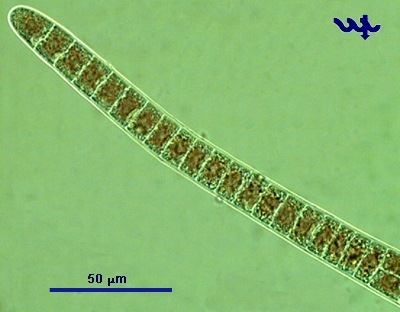
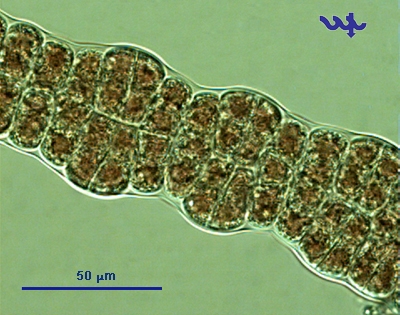
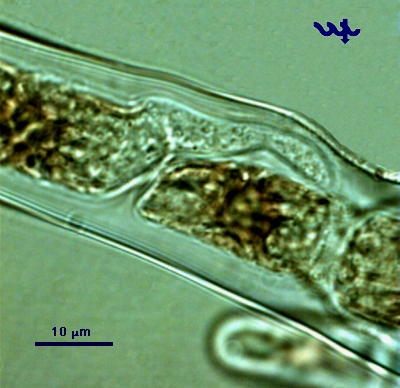
Bangia colonies made of filament aggregation are visible to the naked eye and distinct by their reddish-dark brown to black color (Plate 1). The colonies are attached to surfaces by down-growing , usually in dense purple-black to rust-colored clumps. The individual filaments are gelatinous, unbranched. Young filaments are uniseriate (Plate 2), old filaments are multiseriate (Plate 3). A star-shaped chloroplast with a prominent in the center of each cell is typical of the genus. So are cell elongations (Plate 4) occurring from intercalary cells, they are formed as a step in the reproductive cycle (Gargiulo et al. 2001).
Ecology
Seasonally occurring as a fleecy mat in the of Lake Kinneret on near-shore hard surfaces (often concrete) in extremely shallow waters. It appears in December each year, for a few weeks, then disappears, to re-appear in following years. Since it is absent in the pelagial, where samples for our monitoring program are collected, we have no abundance nor size data for it.
Most Rhodophytes are marine. Only ~ 3% of the ca. 5000 species of Rhodophytes occur in freshwaters, Bangia atropurpurea is one of them.
Most Rhodophytes are marine. Only ~ 3% of the ca. 5000 species of Rhodophytes occur in freshwaters, Bangia atropurpurea is one of them.
Physiological features
Known as being a highly adaptive species due to its stress tolerance. The same species is found in both marine and freshwater environments. Can survive desiccation and extreme solar radiation (in the supra-littoral zone). The species is an indicator of fresh, clear water.
Cite this record as: Dr. Tamar Zohary, Dr. Alla Alster. 3 June 2026. Electronic publication. Israel Oceanographic & Limnological Research. https://kinneret-algae-atlas.org/ Searched on —.